冲
Character Story & Explanation
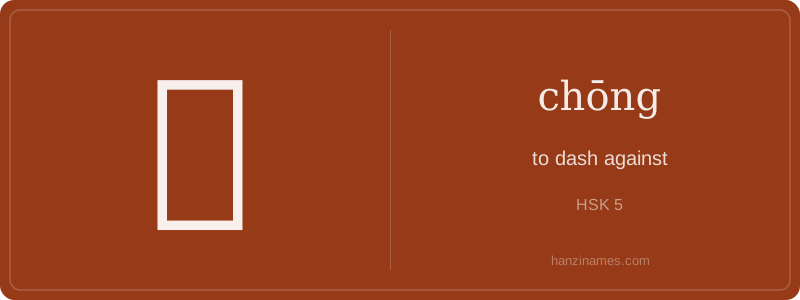
In daily life, 冲 is ubiquitous: people say 冲咖啡 (chōng kāfēi, 'to brew coffee')—a ritualized act of hot water dashing against grounds—and 冲动 (chōngdòng, 'impulse'), reflecting how emotion can surge like a current. Historically, 冲 appears in the 3rd-century BCE text Guanzi as 冲风 ('cutting wind'), describing strategic troop movement against resistance. The idiom 首当其冲 (shǒu dāng qí chōng, 'to be the first hit by the blow') originates from military chronicles, denoting frontline vulnerability and leadership under pressure.
The character evolved from seal script, where 冫 represented ice/water and 中 indicated centrality or a target point. Though not a pictograph, its structure visually encodes directed flow toward a center—mirroring real-world usage: when Chinese students write 冲 during HSK 5 prep, they practice channeling energy purposefully, whether rinsing tea leaves (冲茶) or confronting challenges head-on (迎头赶上, often using 冲 as implied momentum).
The character 冲 (chōng) embodies a dynamic, almost elemental force in Chinese thought—movement that is sudden, directional, and transformative. Its radical 冫 (ice) suggests coldness or stillness, yet the right side 中 (zhōng, 'center') implies focus and alignment. This tension reflects a core Daoist insight: stillness and motion are interdependent; true power arises not from brute force but from precise, centered momentum—like water breaking through rock not by strength alone, but by persistence and direction.
Historically, 冲 appears in classical texts describing military charges, flood surges, and energetic shifts in qi. In traditional medicine and feng shui, 冲 denotes ‘clashing’ energies—e.g., two opposing magnetic directions—that demand resolution, not suppression. This reveals a worldview where conflict isn’t inherently negative but a catalyst for realignment and renewal, echoing the Yijing’s principle that change itself is the only constant.
Even in modern Mandarin, 冲 retains this duality: it can mean to rush forward (冲出去), to neutralize (冲淡), or to provoke (冲撞). Its chòng reading (as in 冲床 'press machine') adds mechanical precision—force applied with calibrated timing. Thus, 冲 captures a distinctly Chinese synthesis: action rooted in awareness, impact guided by intention, and transformation emerging from disciplined encounter—not collision, but *convergent force*.
Example Sentences
Common Compounds
Similar Characters — Don't Mix These Up
Your First Step into Chinese Culture: Get a Chinese Name
Every journey into Chinese begins with a name. Use our free Chinese name generator to create a meaningful, personalized Chinese name that fits you perfectly.
Get My Chinese Name →