泪
Character Story & Explanation
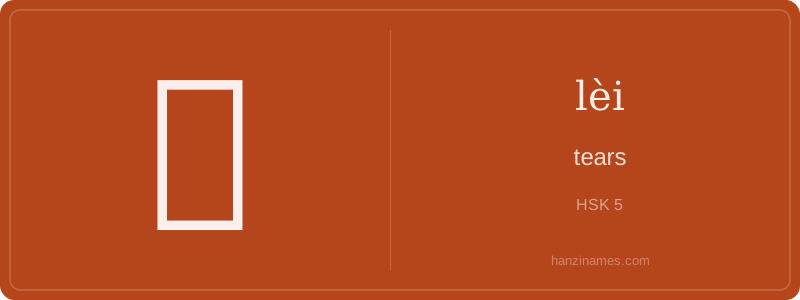
泪 is ubiquitous in modern Mandarin: it appears in daily expressions like ‘流眼泪’ (liú yǎnlèi, 'to shed tears'), news headlines about humanitarian crises ('含泪告别' — 'farewell with tears'), and official memorial language (e.g., '热泪盈眶', 'tears welling up'). It features in the idiom ‘血泪史’ (xuè lèi shǐ, 'history written in blood and tears'), widely used in historical education to describe modern China’s struggles. The character also appears in standardized tests, literature curricula, and public service announcements on mental health—reflecting its cultural weight in expressing collective and personal sorrow.
泪 evolved from the ancient character 淚 (with the ‘eye’ radical 目), first attested in Han dynasty bamboo slips. By the Tang dynasty, the simplified form 泪 (replacing the ‘eye’ component with 氵 + 戾) became common in cursive script and was officially adopted in the 1956 PRC simplification. Its current form emphasizes the *liquid* nature of tears over their ocular origin—a documented typographic shift reflecting pragmatic writing evolution, not mythic symbolism.
The character 泪 (lèi) embodies a profound cultural acknowledgment of tears not as weakness, but as a dignified, embodied response to deep human experience—grief, joy, empathy, or awe. In classical Chinese thought, emotions are seen as vital qi (vital energy) in motion; tears are the visible overflow of inner resonance with life’s intensity. This aligns with Confucian ideals of sincerity (chéng) and Daoist reverence for natural expression—tears flow when the heart is authentically moved, unforced and unashamed.
Unlike Western dualisms that often separate reason from emotion, 泪 reflects a holistic worldview where cognition and feeling co-arise. The water radical 氵 signals its physical origin—bodily fluid—but also evokes liquidity as metaphor: tears dissolve boundaries, soften rigidity, and carry transformative potential, much like water in Daoist philosophy. To shed tears is thus neither shameful nor indulgent, but a sign of moral sensitivity and emotional integrity.
This character appears in poetry, mourning rites, and even medical texts—where ‘excessive tears’ may indicate liver-qi imbalance in Traditional Chinese Medicine. Its presence across disciplines reveals how deeply emotion is woven into Chinese epistemology: tears are data, diagnosis, devotion, and art all at once. Learning 泪 invites learners not just to name a bodily secretion, but to enter a worldview where vulnerability is linguistically honored, ethically grounded, and aesthetically refined.
Example Sentences
Common Compounds
Similar Characters — Don't Mix These Up
Your First Step into Chinese Culture: Get a Chinese Name
Every journey into Chinese begins with a name. Use our free Chinese name generator to create a meaningful, personalized Chinese name that fits you perfectly.
Get My Chinese Name →