测
Character Story & Explanation
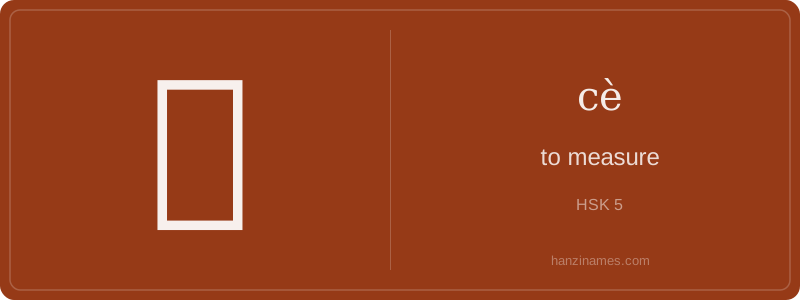
In modern Chinese life, 测 is ubiquitous in science, education, and daily tech: students take 测验 (cèyàn, tests), phones run battery health 测评 (cèpíng, evaluations), and apps offer personality 测试 (cèshì, quizzes). The term 测量 (cèliáng, 'measurement') is foundational in physics curricula and engineering standards. Historically, the *Zhoubi Suanjing* (c. 1st century BCE) used 测 to describe gnomon-based solar altitude measurements—documented early applications in astronomy and cartography.
The character’s form is not pictographic but phono-semantic: 氵 (water radical) signals semantic domain (fluidity, flow, quantification), while 则 (zé) serves as the phonetic component. No oracle-bone or bronze script forms survive for 测—it first appears reliably in clerical script (Lìshū) during the Han dynasty, confirming its later derivation as a specialized compound for technical assessment.
As a detective tracing 测’s evolution, I begin at its radical: 氵—three water dots, signaling association with liquid, flow, or measurement. In ancient China, water levels were critical for irrigation and flood control; surveying land often meant measuring water depth or flow rate. This practical need seeded the character’s core sense of 'measuring'—not just physically, but conceptually, as in assessing conditions or testing outcomes.
The right side, 则 (zé), originally meant 'standard' or 'rule'—a benchmark for comparison. When fused with water (氵), 测 emerged as 'to measure against a standard using observable data', especially fluid-based metrics. Over time, its scope broadened from hydrological surveying to any systematic assessment: academic testing, psychological evaluation, or even forecasting weather—always implying empirical observation and calibration.
By the Han dynasty, 测 appears in texts like the *Book of Han* (《汉书》) describing astronomical measurements and land surveys. Its semantic stability is remarkable: unlike many characters that shifted meaning dramatically, 测 retained its core idea of 'quantitative or qualitative assessment based on evidence'. Today, it still conveys rigor—not guesswork, but methodical probing, whether scanning a QR code or analyzing genomic data.
Example Sentences
Common Compounds
Similar Characters — Don't Mix These Up
Your First Step into Chinese Culture: Get a Chinese Name
Every journey into Chinese begins with a name. Use our free Chinese name generator to create a meaningful, personalized Chinese name that fits you perfectly.
Get My Chinese Name →