滑
Character Story & Explanation
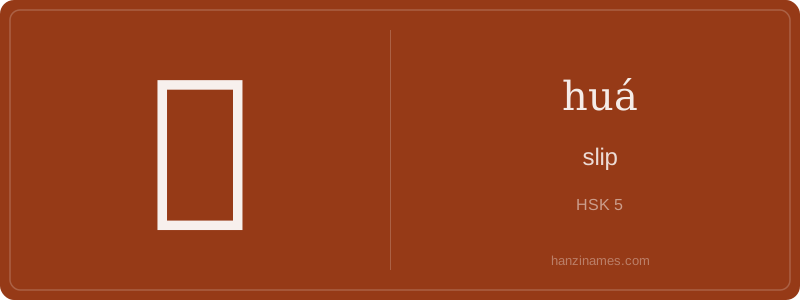
Historically, 滑 appears in early dictionaries like the *Shuōwén Jiězì* (121 CE), defined as ‘to slide; to glide’, with its water radical emphasizing fluid motion. It features in idioms like 滑天下之大稽 (huá tiānxià zhī dà jī)—‘to make a fool of the whole world’—where ‘slip’ metaphorically expands to absurd, face-saving evasion. In daily life, it’s ubiquitous: weather reports warn of 滑路 (huá lù, ‘slippery roads’); chefs describe 滑炒 (huá chǎo, ‘velvety stir-fry’) for tender meat; and tech users say 滑动屏幕 (huá dòng píngmù, ‘slide the screen’).
The character’s form evolved from seal script, where the right side (骨 gǔ, ‘bone’) originally suggested smoothness of surface (e.g., polished bone), later simplified to 禾+口+十—though modern analysis treats the right as phonetic (guā → huá). No oracle-bone evidence exists; its earliest attested forms are in Warring States bamboo texts showing consistent water + phonetic structure.
The character 滑 (huá) embodies a subtle yet pervasive concept in Chinese thought: the interplay between control and surrender, friction and flow. Unlike Western metaphors that often valorize grip and resistance ('hold on', 'stand firm'), 滑 reflects a Daoist-adjacent appreciation for yielding—sliding past obstacles rather than confronting them head-on. This isn’t passivity, but calibrated responsiveness: think of a martial artist redirecting force, or a calligrapher’s brush gliding effortlessly across paper when ink, pressure, and timing align.
Water is central to its worldview: the radical 氵 (three-dot water) signals liquidity as both physical condition and philosophical principle. In classical texts like the *Zhuangzi*, ‘slipperiness’ appears metaphorically—not as failure, but as wisdom that evades rigid categorization. To be 滑 can mean socially adept (even tactfully elusive), linguistically fluent, or physically graceful—always implying mastery through adaptability, not brute effort.
This duality extends into ethics and aesthetics: a ‘smooth’ negotiation (滑头) may carry mild irony, while ‘smooth porcelain’ (滑瓷) denotes refined craftsmanship. Even culinary use—like 滑嫩 (huá nèn, ‘tender-slipping’) for perfectly cooked fish—links texture to virtue: ideal states are effortless, unforced, and harmoniously integrated. Thus, 滑 is less about accidents of slipping and more about the cultivated art of moving with the grain of reality.
Example Sentences
Common Compounds
Similar Characters — Don't Mix These Up
Your First Step into Chinese Culture: Get a Chinese Name
Every journey into Chinese begins with a name. Use our free Chinese name generator to create a meaningful, personalized Chinese name that fits you perfectly.
Get My Chinese Name →