滚
Character Story & Explanation
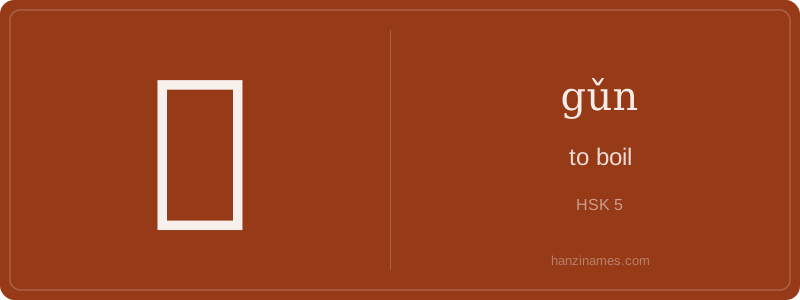
In daily Mandarin, 滚 most commonly signals that water has reached a rolling boil—essential for food safety, tea preparation, and noodle cooking. It appears in imperative phrases like ‘水开了,快下饺子!’ (The water’s boiling—drop the dumplings now!) and is central to culinary instructions across cookbooks and cooking shows. Historically, it appears in the 11th-century *Jiuzhuan Yinfu Jing* (Ninefold Alchemical Manual) describing distillation processes requiring ‘水滚三沸’ (water boiled thrice). It also features in the idiom ‘滚瓜烂熟’, meaning ‘to know something perfectly’—originally referencing melons so ripe they roll off the vine effortlessly.
The character’s form is not pictographic but phono-semantic: the left side 氵 (water) indicates category; the right side 衮 (gǔn) provides both sound and connotation of ‘flowing downward in abundance’. No oracle bone or bronze inscription records exist for 滚—it first appears in regular script during the Tang dynasty, reflecting its late emergence as a specialized term for turbulent boiling.
As an archaeologist sifting through layers of linguistic sediment, I find 滚 not as a static glyph but as a dynamic fossil of motion and heat. Its left radical 氵—three drops of water—anchors it firmly in the realm of liquid behavior. The right component, 衮 (gǔn), originally depicted ceremonial robes flowing downward, later phonetically borrowed to indicate sound. Together, they encode an ancient observation: water under intense heat doesn’t merely bubble—it surges, rolls, and churns with energetic vertical force.
This character’s earliest attested use appears in Tang dynasty medical texts and Song dynasty culinary manuals, where it precisely denotes vigorous boiling—not gentle simmering. Unlike generic verbs for 'heat', 滚 implies turbulence: the visual chaos of bubbles collapsing and reforming, steam erupting, and liquid in full kinetic rebellion. It’s not passive heating; it’s hydrodynamic climax—a semantic nuance preserved across 1,200 years of usage.
What makes 滚 archaeologically compelling is its semantic elasticity: from literal boiling (水滚了) to metaphorical expulsion (滚出去!), yet always retaining its core physics—uncontrolled, outward-directed energy. Even in modern internet slang (‘滚粗’), the visceral imagery remains: something forcefully ejected, like scalding vapor bursting from a kettle. This continuity—from bronze-age cooking pots to smartphone screens—reveals how deeply embodied cognition shapes Chinese script: meaning isn’t abstracted, but *felt* in the body’s memory of heat and motion.
Example Sentences
Common Compounds
Similar Characters — Don't Mix These Up
Your First Step into Chinese Culture: Get a Chinese Name
Every journey into Chinese begins with a name. Use our free Chinese name generator to create a meaningful, personalized Chinese name that fits you perfectly.
Get My Chinese Name →