渐
Character Story & Explanation
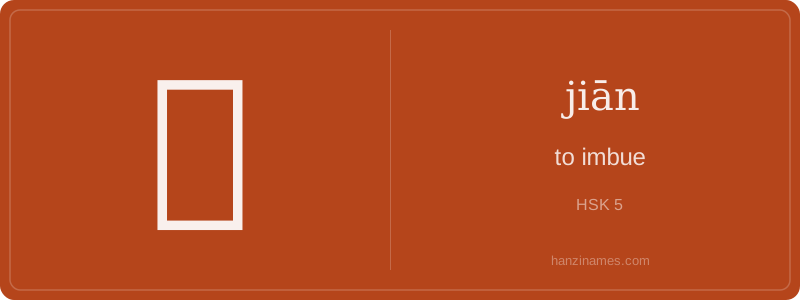
In modern Mandarin, 渐 is rarely used alone but thrives in compounds and adverbs like 渐渐 (jiānjiān, 'gradually') and 日渐 (rì jiān, 'increasingly day by day'). It appears in formal writing, news headlines (e.g., 经济日渐复苏), and classical allusions—most famously in the idiom 循序渐进 (xún xù jiān jìn, 'proceed step by step, gradually advancing'), a cornerstone of Confucian pedagogy cited in Zhu Xi’s commentaries. HSK 5 learners encounter it in academic and literary contexts demanding nuance in expressing incremental change.
The character’s form has no pictographic origin—it evolved from seal script where 氵 + 斬 coalesced phonetically. No oracle bone or bronze inscriptions bear 渐; it first appears reliably in Warring States bamboo slips. So rather than ancient imagery, think of a university student editing an essay: she writes ‘这项改革正逐渐深化’—and pauses, choosing 渐 over 立刻 or 马上, because only 渐 conveys respectful, inevitable, deeply rooted change.
Our detective begins at the crime scene: the character 渐. At first glance, it’s a water radical (氵) paired with 斬—'to chop'—a curious duo. But this isn’t violence—it’s precision. In ancient Chinese script, 斬 was phonetic, not semantic, lending the sound *jiān* while 氵 signaled association with fluid, gradual processes—like water seeping into soil. No abrupt cuts, only steady infiltration.
Zooming in on historical usage, 渐 appears early in classical texts like the *Zuo Zhuan* and *Xunzi*, always marking slow, cumulative change—not sudden transformation. It never meant 'to chop' literally; that meaning belonged solely to 斬. Instead, 渐 functioned as a grammatical marker of progressive aspect, akin to English ‘-ing’ or ‘gradually’, anchoring verbs in time’s gentle current.
The dual pronunciation *jiān* (standard) and *jiàn* (archaic/rare, seen in some dialectal or poetic contexts) reflects phonological shifts over centuries—not two meanings, but one core idea preserved across evolving speech. Even today, when a native speaker says ‘渐渐’, they’re invoking millennia of linguistic continuity: change not as rupture, but as osmosis, diffusion, quiet saturation—the very essence of ‘to imbue’.
Example Sentences
Common Compounds
Similar Characters — Don't Mix These Up
Your First Step into Chinese Culture: Get a Chinese Name
Every journey into Chinese begins with a name. Use our free Chinese name generator to create a meaningful, personalized Chinese name that fits you perfectly.
Get My Chinese Name →