灾
Character Story & Explanation
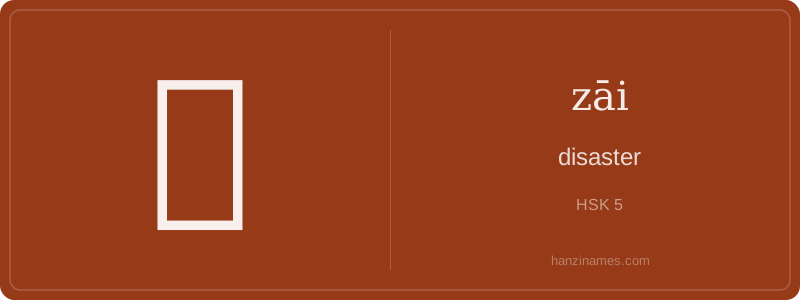
In contemporary China, 灾 appears daily in official discourse, news headlines, and public safety campaigns—e.g., ‘防汛救灾’ (fáng xùn jiù zāi, flood prevention and disaster relief), a key phrase used by the Ministry of Emergency Management since its 2018 establishment. It’s central in the National Emergency Response Plan and appears in legally mandated school drills. Common idioms include 天灾人祸 (tiān zāi rén huò, ‘natural disasters and man-made calamities’), cited in historical records like the Book of Han (c. 1st century CE) to describe dynastic crises.
The character’s documented origin is phono-semantic, not pictographic: the traditional form 災 combines 火 (fire) and 咎 (jiù, ‘fault’), indicating calamity as both destructive force and consequence of error. No oracle bone form exists—its earliest attestation is in late Warring States bamboo slips (4th–3rd c. BCE), confirming its development as a compound, not a drawing of flame or ruin.
As a linguistic detective, I begin with the modern form of 灾: seven strokes, fire radical (火) on the left, and the phonetic component 咎 (jiù) — though simplified, it’s now written as ‘宀+一+丶’ — on the right. This structure signals both meaning (fire-related danger) and sound (zāi is historically linked to jiù in Old Chinese phonology). The simplification in 1956 replaced the traditional form 災, which preserved the full ‘宀+九+火’ layout, making the fire connection even more explicit.
The fire radical isn’t arbitrary—it anchors 灾 in a semantic family of heat, destruction, and urgency: think 灭 (extinguish), 灯 (lamp), or 灵 (spirit—originally tied to ritual fire). In ancient usage, fire was among the most feared natural threats—uncontrollable, rapid, and transformative—so it became the logical pictographic anchor for ‘calamity’. Even today, when Chinese media reports disasters, fire imagery often appears symbolically, reinforcing this deep-rooted association.
Tracing further, oracle bone and bronze inscriptions don’t show 灾 as a standalone character; it emerges later in Warring States bamboo texts and Han dynasty seals, always with fire as its core semantic driver. Unlike characters born from clear pictographs (e.g., 日 for ‘sun’), 灾 evolved as a phono-semantic compound—its power lies not in visual mimicry but in conceptual fusion: fire + human failing (咎 originally meant ‘fault’ or ‘blame’). This reflects an ancient worldview where disaster wasn’t just natural—it was intertwined with moral or cosmic imbalance.
Example Sentences
Common Compounds
Similar Characters — Don't Mix These Up
Your First Step into Chinese Culture: Get a Chinese Name
Every journey into Chinese begins with a name. Use our free Chinese name generator to create a meaningful, personalized Chinese name that fits you perfectly.
Get My Chinese Name →