炭
Character Story & Explanation
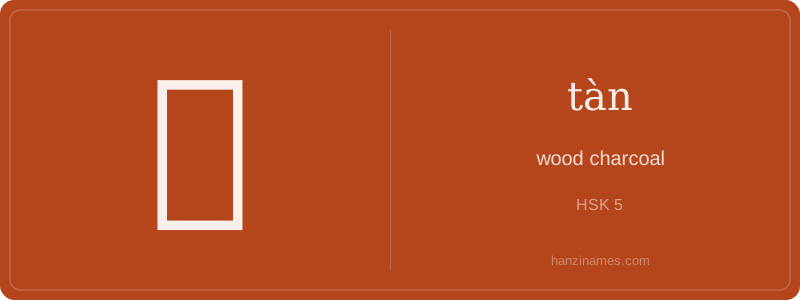
炭 has been documented since the Han dynasty in texts like the Shuōwén Jiězì (c. 121 CE), defined as ‘burnt wood’ (燒木餘也). Historically, it fueled iron smelting, ink production, and domestic heating. Today, it appears in common phrases like 烧炭 (shāo tàn, ‘to make charcoal’) and the idiom 抱薪救火 (bào xīn jiù huǒ, ‘carrying firewood to put out a fire’—a caution against worsening problems), where 炭 underscores fuel’s dual nature as remedy and risk.
The character is not pictographic; its structure is phono-semantic: 火 (fire radical, semantic) + 山 (shān, phonetic, though pronunciation diverged over time). In daily life, Chinese people encounter 炭 most visibly in street-side shāo kǎo stalls, eco-conscious ‘bamboo charcoal’ air purifiers, and HSK 5 vocabulary lists—where it signals mastery of culturally nuanced, medium-frequency terms.
The character 炭 (tàn) embodies a quiet paradox in Chinese worldview: destruction yielding sustenance. Formed from the fire radical (火) and the phonetic component 山 (shān, 'mountain'), it visually captures charcoal’s origin—wood transformed by fire, often harvested from mountain forests. In traditional Chinese thought, fire is not merely destructive but transformative, aligning with the wǔxíng (Five Phases) where fire generates earth (ash), symbolizing cyclical renewal rather than linear loss.
Charcoal occupies a liminal space—neither raw wood nor pure flame, yet essential to both craft and ritual. Its use in inksticks (墨, mò) links it to scholarship and moral cultivation; its role in metallurgy and cooking connects it to material civilization. This duality reflects a core Confucian and Daoist insight: true utility arises not from purity, but from controlled transformation—where heat tempers, refines, and preserves.
In modern China, 炭 persists as a cultural anchor amid industrialization. While coal (煤, méi) dominates energy, wood charcoal retains symbolic weight—in winter heating rituals, barbecue culture (e.g., Beijing’s ‘shāo kǎo’), and environmental discourse about sustainable biomass. Its presence in idioms like 炭薪之忧 (tàn xīn zhī yōu, 'anxiety over fuel') reveals how deeply material scarcity shapes ethical concern—a reminder that philosophy in Chinese tradition often begins not in abstraction, but at the hearth.
Example Sentences
Common Compounds
Similar Characters — Don't Mix These Up
Your First Step into Chinese Culture: Get a Chinese Name
Every journey into Chinese begins with a name. Use our free Chinese name generator to create a meaningful, personalized Chinese name that fits you perfectly.
Get My Chinese Name →