煤
Character Story & Explanation
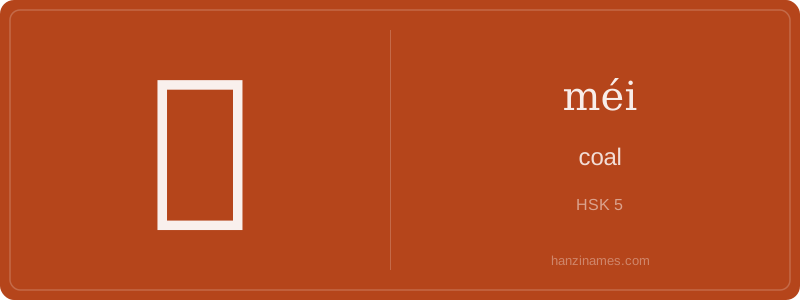
Coal has shaped China’s modern development — historically powering railroads, steel mills, and winter heating across northern provinces. Today, 煤 remains central in policy discourse: ‘coal reduction’ (减煤, jiǎn méi) and ‘clean coal technology’ (清洁煤技术, qīngjié méi jìshù) appear in government white papers and environmental reports. The phrase 煤炭工业 (méitàn gōngyè, ‘coal industry’) is a standard term in economics textbooks and news media.
The character 煤 is not pictographic — no oracle-bone or bronze inscriptions depict it. It first appears in Han-era dictionaries like the 《Shuōwén Jiězì》 (c. 121 CE) as a phono-semantic compound: 火 (meaning) + 某 (sound). In daily life, Chinese people encounter it on utility bills (燃煤费, ‘coal-burning fee’), weather forecasts mentioning ‘coal-heating season’, and environmental apps tracking PM2.5 from coal-fired plants.
Our investigation begins with the radical 火 (huǒ) — 'fire' — unmistakably anchoring 煤 in the realm of combustion and heat. This isn’t coincidental: coal’s primary historical function was fuel, and its very name reflects its role as fire’s source. The right-hand component, 某 (mǒu), originally a phonetic indicator meaning 'certain' or 'some', provides the sound méi while subtly reinforcing coal’s status as a *specific*, indispensable resource — not just any black rock, but *the* combustible one.
Tracing its evolution, 煤 appears reliably in Tang and Song dynasty texts referring to mined carbon-based fuel — notably in records of imperial kilns and northern heating systems. Unlike characters born from oracle-bone pictographs, 煤 is a later phono-semantic compound, standardized during the Han dynasty’s script reforms. Its structure signals both function (fire) and pronunciation (mǒu → méi), exemplifying how Chinese writing systematized practical vocabulary for emerging industrial needs.
The 13-stroke composition reveals disciplined craftsmanship: fire (4 strokes) on the left, 某 (9 strokes) on the right — each stroke deliberate, none ornamental. In clerical script (Lìshū), the fire radical became more angular; in regular script (Kǎishū), it stabilized into today’s form. This character didn’t evolve from myth or metaphor — it emerged from mines, furnaces, and tax ledgers, making it a linguistic artifact of China’s early energy economy.
Example Sentences
Common Compounds
Similar Characters — Don't Mix These Up
Your First Step into Chinese Culture: Get a Chinese Name
Every journey into Chinese begins with a name. Use our free Chinese name generator to create a meaningful, personalized Chinese name that fits you perfectly.
Get My Chinese Name →