营
Character Story & Explanation
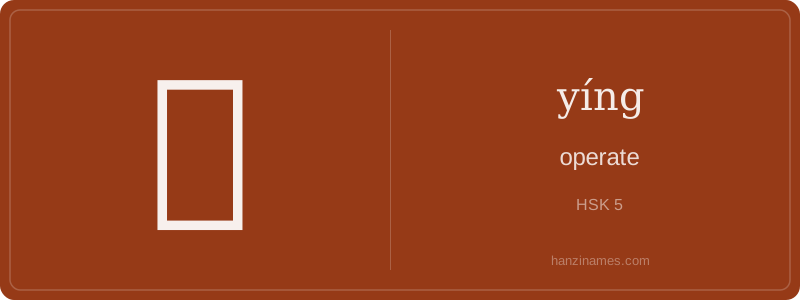
营 is widely used in modern Chinese for organizational activity: businesses 'operate' (经营), government bodies 'administer' (营办), and hospitals 'run' departments (营区, though less common now, historically denoted military medical zones). A well-documented idiom is 苦心经营 (kǔxīn jīngyíng) — 'to painstakingly manage/operate', frequently appearing in business journalism and historical biographies since the Ming-Qing period. It’s also central to compound words like 营业 (yíngyè, 'business operation') and 军营 (jūnyíng, 'military camp'), both standard terms in official media and daily speech.
The character’s seal-script form (c. 3rd c. BCE) shows 艹 (grass/plant) atop 吕 (a phonetic component, later simplified to 火+冖+吕 structure), not a pictograph of a tent. Its origin is semantic-phonetic (形声字), not pictorial. Today, Chinese learners encounter it most concretely in signs like ‘营业中’ (yíngyè zhōng — 'Open for Business') posted on shop doors nationwide.
The character 营 (yíng) opens a window into the Chinese worldview where organization, purposeful activity, and collective endeavor are deeply interwoven with physical space. Though its basic meaning is 'camp', it rarely refers to temporary shelters alone — instead, it evokes structured human presence: military encampments, business operations, or even the careful cultivation of health. This reflects a cultural lens in which space is never neutral; it is always *activated* by intention and sustained effort.
Historically, 营 appears in classical texts like the *Zuo Zhuan* and *Records of the Grand Historian*, describing both battlefield logistics and state administration — revealing how governance itself was conceptualized as 'managing a camp': hierarchical, responsive, and resource-conscious. The character thus bridges martial discipline and civil administration, suggesting that order, whether on a battlefield or in a marketplace, arises from deliberate planning and coordinated action.
This holistic view persists today: a company ‘operates’ (经营, jīngyíng), a hospital ‘runs’ services (营办, yíngbàn), and even traditional medicine speaks of ‘nourishing life’ (营生, yíngshēng). Far from passive occupation, 营 implies active, responsible stewardship — a quiet affirmation that human flourishing requires both spatial grounding and sustained, mindful effort.
Example Sentences
Common Compounds
Similar Characters — Don't Mix These Up
Your First Step into Chinese Culture: Get a Chinese Name
Every journey into Chinese begins with a name. Use our free Chinese name generator to create a meaningful, personalized Chinese name that fits you perfectly.
Get My Chinese Name →