墙
Character Story & Explanation
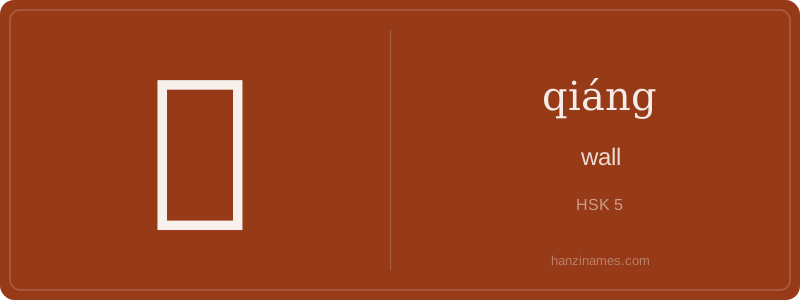
墙 is ubiquitous in modern Chinese life—from real estate listings (‘三室两厅一卫一墙’), construction standards (GB 50003–2011 specifies load-bearing wall requirements), to internet policy ('Great Firewall of China' officially translated as 中国国家防火墙). The idiom 隔墙有耳 (gé qiáng yǒu ěr, 'there are ears beyond the wall') appears in Ming-dynasty vernacular fiction and remains common in warnings about eavesdropping.
墙 is a phono-semantic compound: the left radical 土 (tǔ, 'earth/soil') signals material origin (traditional walls were rammed earth or adobe), while the right component 蔷 (qiáng, originally a phonetic element from the plant name 蔷薇, 'rose') provides sound. Though 蔷 was later simplified to 强 in modern writing, the original phonetic link to 'qiáng' remains historically documented in Shuōwén Jiězì commentary.
The Chinese character 墙 (qiáng) denotes a physical barrier—typically a vertical structure made of brick, stone, or concrete—that encloses, divides, or protects space. Unlike English 'wall', which can be metaphorical (e.g., 'wall of silence'), 墙 retains strong material concreteness in everyday usage, though modern contexts have expanded its figurative use—especially in political and digital discourse.
In Chinese architecture and urban life, walls carry layered significance: historically, city walls (如城墙) symbolized sovereignty and defense; today, residential compound walls reflect privacy norms and social boundaries. Western equivalents like 'fence' or 'barrier' often imply permeability or temporariness, whereas 墙 suggests solidity, permanence, and authority—echoing Confucian ideals of order and separation.
Culturally, 墙 appears in idioms like 铁壁铜墙 (tiě bì tóng qiáng, 'iron wall and bronze rampart')—emphasizing impregnability—and in modern metaphors like 防火墙 (fáng huǒ qiáng, 'firewall'), directly borrowed into global tech lexicon. This reflects how Chinese linguistic evolution absorbs foreign concepts while anchoring them in native semantic frameworks rooted in tangible, built environments.
Example Sentences
Common Compounds
Similar Characters — Don't Mix These Up
Your First Step into Chinese Culture: Get a Chinese Name
Every journey into Chinese begins with a name. Use our free Chinese name generator to create a meaningful, personalized Chinese name that fits you perfectly.
Get My Chinese Name →