狡
Character Story & Explanation
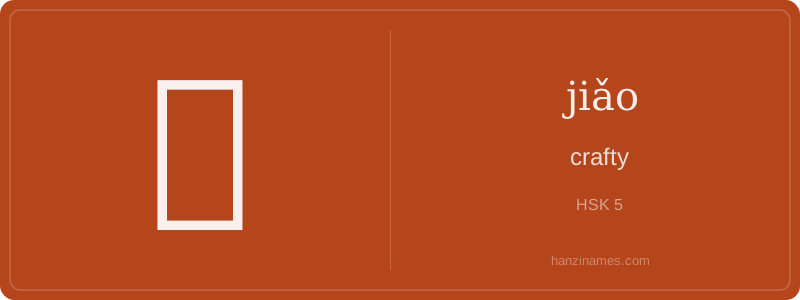
In modern Chinese, 狡 appears almost exclusively in fixed literary or idiomatic expressions—not in casual speech. It features prominently in the idiom 狡兔三窟 (jiǎo tù sān kū, 'a crafty hare has three burrows'), derived from the *Strategies of the Warring States*, describing strategic redundancy for survival. It also occurs in formal registers: political commentary (e.g., 狡辩, 'evasive argument'), legal writing, and historical fiction. Its use signals rhetorical sophistication—and often disapproval.
The character’s form is well-documented: 狡 is a phono-semantic compound. The left radical 犭 (quǎn, ‘beast’) conveys the animalistic, instinct-driven connotation; the right component 交 (jiāo) provides phonetic approximation (jiǎo evolved from jiāo via tone shift). No oracle bone or bronze script precursors exist for 狡—it first appears in Warring States bamboo texts, confirming its late emergence as a specialized term for morally fraught intelligence.
As an archaeologist sifting through layers of linguistic sediment, I uncover 狡 not as a static glyph but as a behavioral fossil—preserved evidence of how ancient Chinese observers encoded moral judgment in zoological metaphor. Its radical 犭 (‘dog’ or ‘beast’) signals instinctual, untamed agency, while the phonetic component 交 (jiāo) hints at entanglement, reciprocity, and strategic exchange—suggesting craftiness arises not from malice alone, but from calculated interaction with one’s environment.
This character emerged fully formed in seal script (c. 4th–3rd century BCE), already bearing its semantic weight: not mere cleverness, but intelligence deployed with self-interest and concealment. Unlike neutral terms like 聪 (cōng, 'intelligent'), 狡 carries an evaluative charge—like finding a fox’s den in a Warring States tomb mural: admired for its cunning, yet morally ambiguous, never virtuous in Confucian texts.
Excavating classical usage reveals 狡 consistently paired with negative valence: in the *Zuo Zhuan*, it modifies treacherous ministers; in Han dynasty legal documents, it labels deceitful testimony. Its lexical field is tightly bound to deception, evasion, and tactical guile—not ingenuity or wit. This isn’t the ‘clever fox’ of Aesop, but the fox that undermines trust. The character thus functions as a cultural artifact: a warning inscription on bronze ritual vessels, reminding elites that craftiness without integrity erodes authority.
Example Sentences
Common Compounds
Similar Characters — Don't Mix These Up
Your First Step into Chinese Culture: Get a Chinese Name
Every journey into Chinese begins with a name. Use our free Chinese name generator to create a meaningful, personalized Chinese name that fits you perfectly.
Get My Chinese Name →