猾
Character Story & Explanation
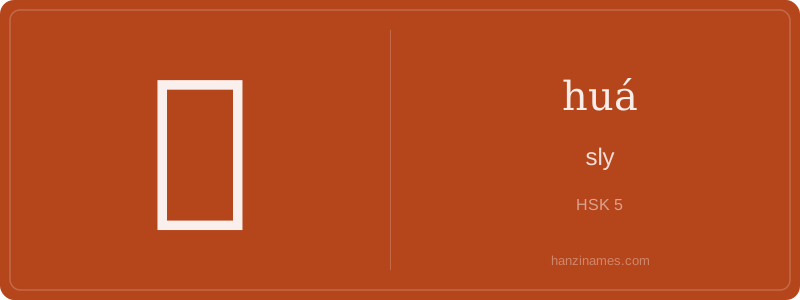
猾 is commonly used in formal and literary contexts to describe morally flexible behavior — especially in governance, business negotiation, or courtroom rhetoric. A well-documented phrase is 猾吏 (huá lì), appearing in historical records such as the *Ming Shi* (History of Ming) to criticize officials who evade oversight through procedural manipulation. Modern usage includes media reports on tax-avoidance schemes ('猾商' — huá shāng, 'sly merchants') and educational critiques of students who game grading systems.
The character combines the 'dog' radical 犭 (indicating animal-like instinct or behavior) with 化 (huà, 'to change, transform'). This reflects its semantic logic: behavior that shifts shape to suit advantage — not brute force, but adaptive cunning. While not pictographic, its structure has been stable since seal script (c. 3rd century BCE), confirming its long-standing association with strategic, untrustworthy adaptability.
The Chinese character 猾 (huá) conveys a nuanced form of cunning — not merely deceitful, but cleverly evasive, subtly manipulative, and socially adaptive. Unlike English 'sly', which often carries a light, almost charming connotation (e.g., 'a sly smile'), 猾 leans toward moral ambiguity: it implies intelligence used to avoid accountability or exploit loopholes. It’s rarely flattering — describing someone as 猾 suggests wariness is warranted.
This term appears frequently in classical and modern critiques of bureaucracy, commerce, and interpersonal conduct. In Confucian-influenced discourse, 猾 contrasts sharply with virtues like 诚 (chéng, sincerity) and 直 (zhí, straightforwardness). Its negative weight is stronger than synonyms like 聪明 (cōngmíng, intelligent) or 机灵 (jīling, quick-witted), both of which lack the ethical stain embedded in 猾.
Culturally, 猾 resonates with Western archetypes like the trickster — think Loki or Anansi — but differs in key ways: those figures often catalyze change or reveal truth, whereas 猾 typically serves self-preservation without redemptive function. In Chinese political satire or anti-corruption narratives, calling an official '猾吏' (huá lì, 'sly official') is a serious indictment rooted in centuries of administrative critique, notably in Ming-Qing era legal texts and vernacular fiction like *The Scholars*.
Example Sentences
Common Compounds
Similar Characters — Don't Mix These Up
Your First Step into Chinese Culture: Get a Chinese Name
Every journey into Chinese begins with a name. Use our free Chinese name generator to create a meaningful, personalized Chinese name that fits you perfectly.
Get My Chinese Name →