率
Character Story & Explanation
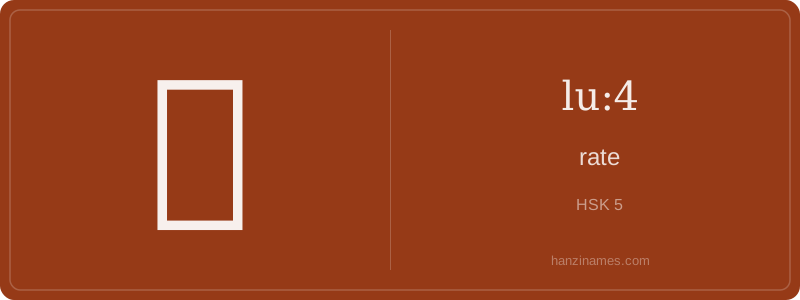
In modern Chinese, 率 (lǜ) appears ubiquitously in official statistics, news reports, and education—e.g., 失业率 (shīyè lǜ, unemployment rate), 出生率 (chūshēng lǜ, birth rate), and 成功率 (chénggōng lǜ, success rate). A well-documented idiom is 百分之百 (bǎifēn zhī bǎi, 'one hundred percent'), where 率 is implied in the structure. Government white papers (e.g., China’s 2023 Statistical Bulletin) use it over 200 times per page for demographic and economic metrics.
The character’s earliest attested form appears in Warring States bamboo texts as a phonosemantic compound: 玄 (radical, indicating profundity/standard) + 卒 (cù, later simplified to 亠+厶+点), originally signifying ‘troop unit’—reflecting its origin in military logistics. No oracle bone form survives; its shape stabilized in Qin small seal script circa 220 BCE.
As an archaeologist brushing dust from a Han dynasty bamboo slip, I find 率 inscribed in clerical script—not as a dry statistic, but as a living measure of imperial order: tax quotas, troop mobilization rates, and grain yield ratios. Its radical 玄 (xuán, 'profound/dark') hints not at color, but at the unfathomable precision required to govern vast territories—where a 5% miscalculation in conscription rate could collapse a frontier garrison.
The character’s dual pronunciations reveal historical stratification: shuài (‘to lead’) preserves its early bronze-inscription sense—commanding troops or rituals—while lǜ (‘ratio’) crystallized later, during the Warring States’ bureaucratic reforms, when states like Qin standardized weights, measures, and statistical reporting across counties.
Examining Song dynasty mathematical manuscripts, I see 率 deployed with astonishing rigor: in Yang Hui’s 1261 treatise, it quantifies ‘the ratio of circumference to diameter’ (π), long before Western notation. Here, 率 isn’t abstraction—it’s carved into abacus beads, inked onto tax ledgers, and chanted by exam candidates memorizing the Nine Chapters’ proportional algorithms.
Example Sentences
Common Compounds
Similar Characters — Don't Mix These Up
Your First Step into Chinese Culture: Get a Chinese Name
Every journey into Chinese begins with a name. Use our free Chinese name generator to create a meaningful, personalized Chinese name that fits you perfectly.
Get My Chinese Name →