疗
Character Story & Explanation
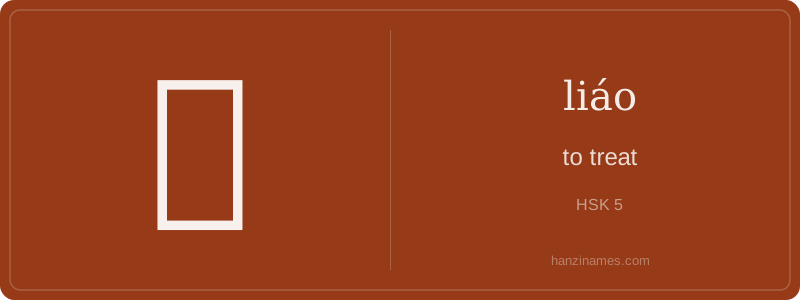
In modern Chinese, 疗 is rarely used alone—it's nearly always embedded in compounds like 治疗 (zhìliáo, 'medical treatment'), 康复治疗 (kāngfù zhìliáo, 'rehabilitation therapy'), or the widely used term 心理治疗 (xīnlǐ zhìliáo, 'psychotherapy'). The 2020 National Health Commission guidelines explicitly use 治疗 over 12,000 times, cementing its role in formal healthcare discourse. Historically, it appears in Ming–Qing dynasty medical texts such as *Yi Zong Jin Jian*, where 治疗 consistently denotes physician-administered interventions—not folk remedies or spiritual rites.
The character’s written form has no pictographic origin; it’s a later-developed phono-semantic compound. Its earliest attested form appears in Han-era clerical script inscriptions on bamboo slips from Zhangjiashan (c. 186 BCE), showing 疒 + 尞—confirming its constructed, not iconic, nature. Today, Chinese students learn it in HSK 5 textbooks as part of health-related vocabulary, often paired with words like 疾病 (jíbìng, 'disease') and 预防 (yùfáng, 'prevention').
As a linguistic detective, I begin at the scene: the character 疗 appears in standardized seal script (c. 221 BCE) and clerical script (Han dynasty), not earlier oracle bone or bronze inscriptions—meaning it emerged after Chinese writing matured for administrative and medical record-keeping. Its left-side radical 疒 (nè, 'sickness') is a well-documented classifier for illness-related characters, always appearing as a two-stroke 'illness canopy' over the right component. This structural consistency signals deliberate semantic categorization—not organic pictographic evolution.
The right side, of course, is 辽 (liáo)—but not the modern place name. In early forms, it was 尞 (liǎo), an ancient phonetic component meaning 'to ascend' or 'to rise', later simplified to 辽 and then to 疗’s current shape. Historical phonology confirms that 尞 carried the *liáu* sound in Middle Chinese, aligning with modern liáo. So this is a classic phono-semantic compound: 疒 conveys meaning (illness), 尞/辽 provides sound—and together they encode 'to treat' as an action that lifts or alleviates sickness.
Crucially, 疗 never stood alone in classical texts. It appears almost exclusively in compound form—like 治疗 (zhìliáo, 'treatment') or 疗养 (liáoyǎng, 'convalescence')—reflecting how pre-modern Chinese medicine conceptualized healing as a process, not an isolated verb. Even in Tang dynasty medical manuscripts such as Sun Simiao’s *Qian Jin Yao Fang*, 疗 functions only as the second syllable in disyllabic verbs. Its grammatical dependence reveals a deep cultural truth: treatment was relational, contextual, and never abstracted from care.
Example Sentences
Common Compounds
Similar Characters — Don't Mix These Up
Your First Step into Chinese Culture: Get a Chinese Name
Every journey into Chinese begins with a name. Use our free Chinese name generator to create a meaningful, personalized Chinese name that fits you perfectly.
Get My Chinese Name →