脑
Character Story & Explanation
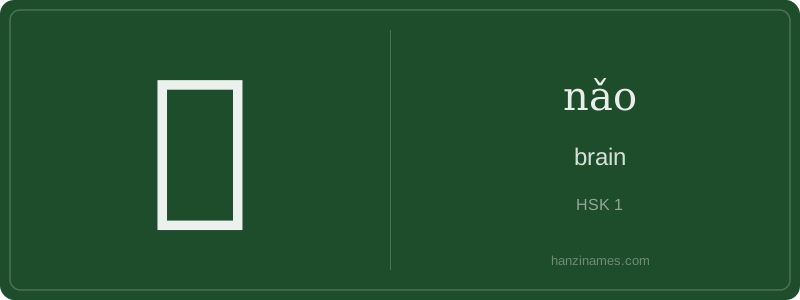
脑 is ubiquitous in modern Chinese daily life—from health campaigns ('Protect your brain' — 保护大脑, bǎohù dà nǎo) to education slogans ('Think with your brain!' — 动脑筋!dòng nǎo jīn!). It appears in six HSK Level 4+ compounds, including the widely used 头脑 (tóunǎo, 'mind/intellect') and 脑筋 (nǎojīn, 'mental effort'). The idiom '伤脑筋' (shāng nǎojīn, 'to hurt one’s brain') is colloquially used for any vexing problem—documented in mid-20th-century vernacular literature and still heard daily on Chinese social media.
The character’s form evolved from seal script (c. 3rd century BCE), where ⺼ (the 'flesh' radical) combined with 勹 (a wrapping shape) and 冂 (a covering element), symbolizing the brain encased within the skull. While no oracle bone inscription of 脑 survives (likely due to its late semantic emergence in writing), its structure consistently signals 'internal soft tissue'—a pattern shared with other ⺼-radical characters like 肝 (liver) and 肺 (lung).
The Chinese character 脑 (nǎo) represents the physical organ 'brain' and, by extension, cognition, intelligence, and mental activity. Unlike English—where 'brain' is strictly anatomical—Chinese uses 脑 in rich idiomatic and metaphorical ways: 'using one’s brain' (动脑, dòng nǎo) means thinking critically, and 'brainstorming' is literally 'collective brain activity' (头脑风暴, tóunǎo fēngbào). This reflects a holistic view where the brain is inseparable from intention, effort, and social collaboration.
In traditional Chinese medicine (TCM), the brain (脑) was historically considered a 'sea of marrow' (髓海, suǐ hǎi) subordinate to the heart’s role as the seat of consciousness—a contrast to Western dualism that locates mind solely in the brain. Though modern Chinese science fully adopts the neurological definition, cultural expressions retain layered meanings: calling someone 'a clever brain' (聪明的脑, cōngmíng de nǎo) emphasizes cultivated acuity, not innate biology.
Western education often treats the brain as a computational device—'hardwiring', 'processing power', 'neural networks'. In contrast, 脑 appears in moral and pedagogical contexts: teachers urge students to 'use their brains' (用脑, yòng nǎo) not just for logic, but for reflection, creativity, and ethical judgment. Even HSK Level 1 textbooks introduce 脑 alongside verbs like 想 (think) and 记 (remember), reinforcing its functional, action-oriented role—not as a static object, but as an active, trainable faculty.
Example Sentences
Common Compounds
Similar Characters — Don't Mix These Up
Your First Step into Chinese Culture: Get a Chinese Name
Every journey into Chinese begins with a name. Use our free Chinese name generator to create a meaningful, personalized Chinese name that fits you perfectly.
Get My Chinese Name →