益
Character Story & Explanation
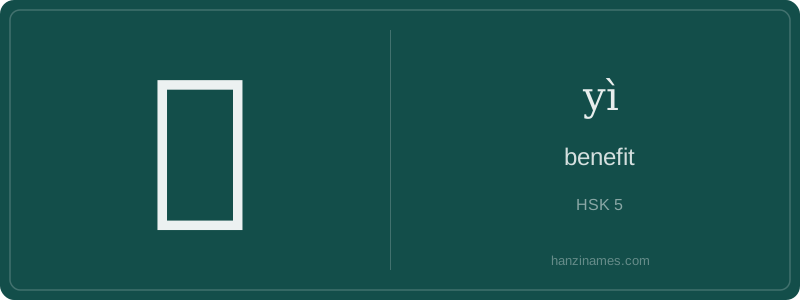
益 appears frequently in modern Chinese public discourse — especially in policy documents, health campaigns, and education slogans. For example, the phrase '素质教育' (sùzhì jiàoyù, 'quality-oriented education') is a nationwide reform term where 益 conveys holistic development benefits. It's also central in idioms like '多多益善' (duōduō yì shàn, 'the more, the better'), recorded since the Han dynasty in the Records of the Grand Historian.
The character’s earliest confirmed form appears in bronze inscriptions (c. 11th–3rd century BCE) as a pictograph showing steam rising from a covered vessel — interpreted by scholars like Xu Shen (in Shuōwén Jiězì, 121 CE) as 'abundance overflowing from a container', evolving into its modern meaning of 'gain' or 'benefit'. No oracle bone form survives, but its bronze-era shape strongly supports this 'overflowing abundance' origin.
Hi students! Let’s learn 益 (yì), a Level 5 HSK character meaning 'benefit', 'advantage', or 'to benefit'. It’s not just about material gain — it often implies moral, health, or long-term value. Think of it as 'what truly adds goodness to life'. You’ll see it in formal writing, news headlines, and academic texts more than casual chat — so mastering it helps you understand serious, thoughtful Chinese.
This character has 10 strokes and belongs to the 皿 (dish/vessel) radical — hinting at its ancient connection to 'something poured into or added to a container', symbolizing accumulation of value. Though it looks complex, break it down: top is 丷 (like 'open arms'), middle is 一 (a horizontal line), and bottom is 皿 — picture 'adding something beneficial into a vessel'.
Don’t confuse 益 with similar-sounding characters like 意 (yì, 'meaning') or 易 (yì, 'easy'). Its tone is fourth (yì), like 'ee-dee' said sharply downward. Practice saying it while writing slowly: yì — like rejecting something firmly ('No!') but with kindness. Try using it in phrases like '有益健康' (yǒuyì jiànkāng) — 'beneficial to health' — a very common expression on food labels and wellness articles.
Example Sentences
Common Compounds
Similar Characters — Don't Mix These Up
Your First Step into Chinese Culture: Get a Chinese Name
Every journey into Chinese begins with a name. Use our free Chinese name generator to create a meaningful, personalized Chinese name that fits you perfectly.
Get My Chinese Name →