眠
Character Story & Explanation
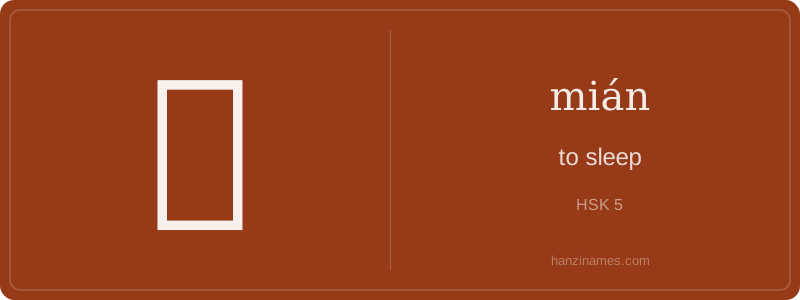
In modern China, 眠 appears daily in health apps, hospital signage ('睡眠监测' — sleep monitoring), and news headlines about sleep deprivation among students and tech workers. It’s central to the widely cited 2021 Chinese Sleep Research Society report highlighting rising insomnia rates. Common phrases include 失眠 (shīmián, insomnia) and 午眠 (wǔmián, midday nap)—a culturally endorsed practice still observed in many schools and enterprises.
The character’s form is not pictographic but phono-semantic: 目 (eye) is the semantic radical, indicating association with vision or visual state (closed eyes = sleep); 民 (mín) is the phonetic component, preserving an ancient pronunciation link (Old Chinese *mər). While its earliest attestation is in Warring States bamboo texts (c. 4th century BCE), no oracle bone form exists—its structure stabilized during the Qin standardization of script.
眠 (mián) is a beautifully balanced character that evokes quiet stillness—its left side 目 (mù), meaning 'eye,' suggests closed eyes, while the right side 民 (mín), meaning 'people' or 'common folk,' subtly implies the universal human need for rest. Though 民 isn’t phonetic here in modern pronunciation, historically it contributed to the sound and reinforced the idea of collective, natural sleep rhythms.
This character appears frequently in literary and formal contexts—not in casual speech like 'I’m sleepy' (which uses 困, kùn)—but in poetic, medical, or biological usage: hibernation (冬眠), insomnia (失眠), or even figurative dormancy (沉眠). Its elegance reflects how Chinese values rest not as laziness, but as essential, cyclical renewal.
At HSK Level 5, 眠 signals a shift from basic vocabulary to nuanced, abstract concepts. Learners encounter it in essays on health, ecology, or classical poetry—e.g., Li Bai’s line '长眠' (cháng mián, 'eternal sleep')—where it carries solemnity and depth. Mastering 眠 means understanding how Chinese language layers physiological states with cultural resonance, turning a simple verb into a vessel for time, peace, and mortality.
Example Sentences
Common Compounds
Similar Characters — Don't Mix These Up
Your First Step into Chinese Culture: Get a Chinese Name
Every journey into Chinese begins with a name. Use our free Chinese name generator to create a meaningful, personalized Chinese name that fits you perfectly.
Get My Chinese Name →