瞧
Character Story & Explanation
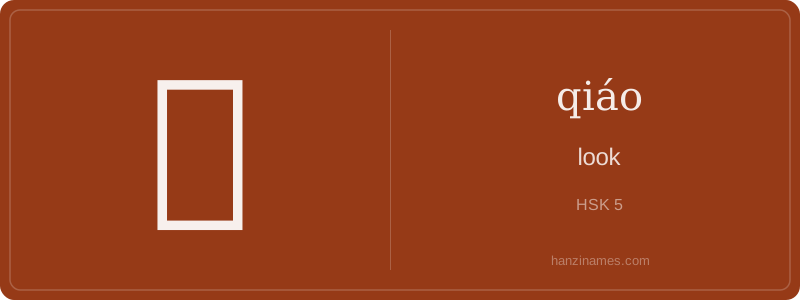
瞧 is widely used in spoken Mandarin, especially in northern dialects and informal registers, to add vividness or mild skepticism: '你瞧瞧!' (Nǐ qiáo qiao! — 'Look at that!') functions like an interjection, common in daily conversation, TV dramas, and stand-up comedy. It appears in idioms like 瞧不起 (qiáo bu qǐ, 'to look down upon') — a fixed compound documented since the Ming-Qing transition and still prevalent in modern usage. Historically, 瞧 emerged as a vernacular variant of 看 during the late imperial period, gaining prominence in vernacular novels and folk literature.
The character is not pictographic in origin; it’s a phono-semantic compound: 目 (radical, 'eye') + 乔 (phonetic, qiáo). While 乔 originally meant 'tall tree' (in oracle bone script), its use here is purely phonetic. Today, Chinese speakers most commonly use 瞧 in exclamatory or emphatic contexts — e.g., urging someone to notice irony ('你瞧,他又迟到了!') — making it a linguistic marker of shared attention and social commentary.
瞧 (qiáo) is more than a neutral verb for 'to look' — it carries a subtle, often conversational emphasis, implying active, intentional, and sometimes curious or skeptical observation. Unlike the plain 看 (kàn), 瞧 suggests leaning in, squinting slightly, or pausing to take something in — as if the act of seeing bridges perception and judgment. This reflects a Chinese linguistic tendency where verbs encode attitude: how you look matters as much as what you see.
In classical and vernacular Chinese alike, 瞧 appears frequently in dialogues and storytelling, especially in Beijing opera scripts and early 20th-century vernacular fiction (e.g., Lao She’s works), where it conveys immediacy and colloquial authenticity. Its presence signals not passive vision but engaged witnessing — aligning with Confucian-influenced values that link observation to moral discernment and situational awareness.
The radical 目 (eye) anchors 瞧 in embodied perception, while the phonetic component 乔 (qiáo, meaning 'tall' or 'lofty') subtly evokes elevation — looking *up*, *over*, or *beyond*. This duality mirrors the Chinese worldview: seeing is never detached; it’s relational, contextual, and often hierarchical — whether gazing at elders, inspecting craftsmanship, or appraising social nuance. To 瞧 is to participate visually in the fabric of human interaction.
Example Sentences
Common Compounds
Similar Characters — Don't Mix These Up
Your First Step into Chinese Culture: Get a Chinese Name
Every journey into Chinese begins with a name. Use our free Chinese name generator to create a meaningful, personalized Chinese name that fits you perfectly.
Get My Chinese Name →