砍
Character Story & Explanation
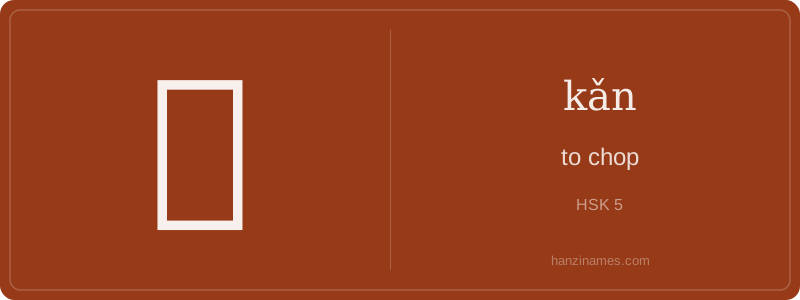
砍 is widely used in modern Mandarin for both literal and figurative chopping. Common phrases include 砍价 (kǎnjià, 'to bargain') — a daily activity in Chinese markets — and 砍树 (kǎn shù, 'to fell trees'), frequently seen in environmental news. The idiom 大刀阔斧 (dà dāo kuò fǔ, 'with broad axes and large knives') uses 砍 implicitly to describe decisive, forceful action. Historically, 砍 appears in Ming and Qing dynasty texts describing timber harvesting and military tactics.
The character evolved from seal script, where the left side clearly represented stone (石), and the right side was a simplified depiction of a person holding a tool — later standardized as 欠. While not a pictograph of an axe itself, its form consistently reflects tool-based, downward striking action since at least the Han dynasty bamboo slips.
Hi students! Let’s learn 砍 (kǎn), a Level 5 HSK character meaning 'to chop' — like using an axe or knife to cut something forcefully. It’s not gentle cutting (that’s 切 qiē); 砍 implies downward, powerful motion, often with tools like axes, machetes, or even metaphorically in speech ('chopping down' arguments). Its radical is 石 (shí, 'stone'), which may seem surprising — but historically, early chopping tools were stone axes, so the radical reflects that ancient material context.
This character appears in many practical contexts: logging, cooking (chopping meat or vegetables), martial arts (e.g., sword strikes), and even digital slang (like 砍价 — 'to bargain', literally 'chop price'). Though it’s Level 5, you’ll hear it often in markets, kitchens, and news reports about deforestation or construction. Pay attention to tone — kǎn is third tone, so your voice dips then rises slightly.
Writing it? Nine strokes — start with the stone radical on the left (石), then the right side ‘欠’ (qiàn, 'to lack') — but here it’s purely phonetic, not semantic. Don’t confuse it with similar-looking characters like 吹 (blow) or 次 (next). Practice writing slowly: first the stone part (top horizontal, vertical, then the 'mouth' shape), then the right side’s stroke order. Repetition builds muscle memory!
Example Sentences
Common Compounds
Similar Characters — Don't Mix These Up
Your First Step into Chinese Culture: Get a Chinese Name
Every journey into Chinese begins with a name. Use our free Chinese name generator to create a meaningful, personalized Chinese name that fits you perfectly.
Get My Chinese Name →