碍
Character Story & Explanation
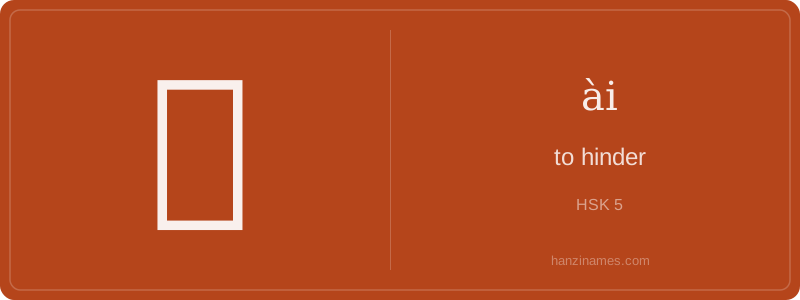
碍 is widely used in modern standard Chinese, especially in formal writing, news reports, and policy documents. A well-documented idiom is ‘有碍观瞻’ (yǒu ài guān zhān), meaning 'damaging to appearances' — frequently cited in official media when describing inappropriate public behavior. Another common phrase is ‘妨碍交通’ (fáng’ài jiāo tōng, 'to obstruct traffic'), appearing regularly in traffic regulations and news headlines across China since the 1980s.
The character’s earliest documented form appears in seal script (c. 3rd century BCE), combining 石 (stone) and 嫒 (a phonetic component derived from 嫒, now obsolete). While its original pictographic origin is lost, the stone radical consistently signals material obstruction — matching how modern speakers use it today, e.g., saying ‘视力有碍’ (shìlì yǒu ài, 'impaired vision') to describe functional hindrance.
Hi students! Today we’re learning the character 碍 (ài), which means 'to hinder' or 'to obstruct'. It’s a verb used when something gets in the way — like a physical barrier, a rule, or even an emotional hesitation. Though it looks complex with 13 strokes, notice its structure: the left side is 石 (shí), meaning 'stone', suggesting something solid and blocking; the right side is 嫒 (ài), which provides sound and hints at restriction. This character appears often in formal and written Chinese — less in casual speech, but essential for HSK 5 fluency.
Don’t confuse 碍 with similar-sounding characters like 爱 (ài, 'to love') — they share pronunciation but differ completely in meaning and writing. The stone radical (石) is your anchor: it tells you this character relates to something tangible, immovable, or obstructive. Think of it like a boulder in a path — it doesn’t move, and you must go around it or remove it. That’s the core idea behind 碍.
In grammar, 碍 is rarely used alone. You’ll almost always see it in compounds like 阻碍 (zǔ’ài, 'to impede') or 妨碍 (fáng’ài, 'to interfere with'). It’s also common in negative constructions like ‘不碍事’ (bù ài shì, 'It’s no problem'), where it carries a softened, idiomatic meaning. Mastering these patterns helps you sound natural — not just correct — in real conversations and exams.
Example Sentences
Common Compounds
Similar Characters — Don't Mix These Up
Your First Step into Chinese Culture: Get a Chinese Name
Every journey into Chinese begins with a name. Use our free Chinese name generator to create a meaningful, personalized Chinese name that fits you perfectly.
Get My Chinese Name →