税
Character Story & Explanation
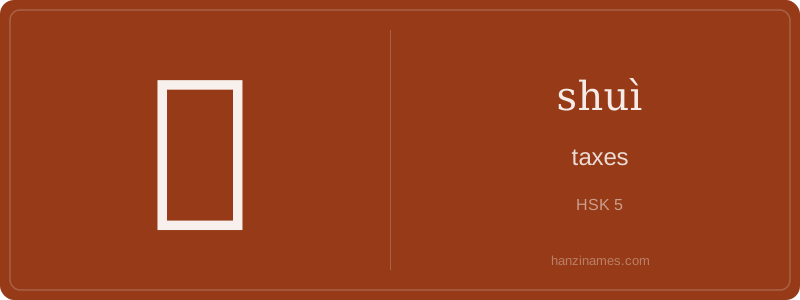
税 is ubiquitous in modern Chinese life: citizens file annual individual income tax (IIT) returns via the 'Personal Income Tax' app launched in 2019; businesses issue VAT invoices (增值税专用发票) daily; and local governments collect property tax (房产税) in pilot cities like Shanghai since 2011. The term appears in official slogans like '依法纳税,利国利民' ('Pay taxes lawfully—for the nation and the people'). A common phrase is 纳税人 (nàshuìrén, 'taxpayer'), widely used in media and legal documents.
The character 税 first appeared in bronze inscriptions of the Warring States period (475–221 BCE) as a compound of 禾 (grain, symbolizing agricultural wealth) and 兑 (duì, originally meaning 'exchange' or 'fulfillment', later simplified to 兑 in modern form). Its earliest attested use refers to grain levies imposed by feudal lords—confirming its ancient link to state extraction of agricultural surplus.
The Chinese character 税 (shuì) denotes 'taxes'—a mandatory financial contribution to the state, deeply embedded in China’s administrative and legal frameworks. Unlike voluntary donations or fees for services, 税 carries legal enforceability and civic obligation, reflecting Confucian-influenced ideals of collective responsibility and state-society reciprocity. Its usage spans income tax, value-added tax (VAT), and property tax, all governed by the People’s Republic of China Tax Collection and Administration Law.
In Western contexts, 'tax' often evokes individual rights discourse—e.g., 'no taxation without representation'—whereas 税 emphasizes duty within a harmonious social order. While U.S. or UK tax systems prioritize taxpayer rights and appeals processes, China’s approach historically stresses compliance, with digital enforcement (e.g., Golden Tax Project) reducing evasion. This reflects differing philosophical roots: liberal individualism vs. relational governance.
Despite structural differences, global trends like BEPS (Base Erosion and Profit Shifting) initiatives show convergence—China actively participates in OECD-led tax cooperation. Yet culturally, 税 remains tied to notions of 'serving the people' (为人民服务) and national development, not just revenue generation. Public awareness campaigns, such as annual 'Taxation Promotion Month' since 1992, reinforce its role in building infrastructure and welfare—framing taxes as shared investment, not mere burden.
Example Sentences
Common Compounds
Similar Characters — Don't Mix These Up
Your First Step into Chinese Culture: Get a Chinese Name
Every journey into Chinese begins with a name. Use our free Chinese name generator to create a meaningful, personalized Chinese name that fits you perfectly.
Get My Chinese Name →