窄
Character Story & Explanation
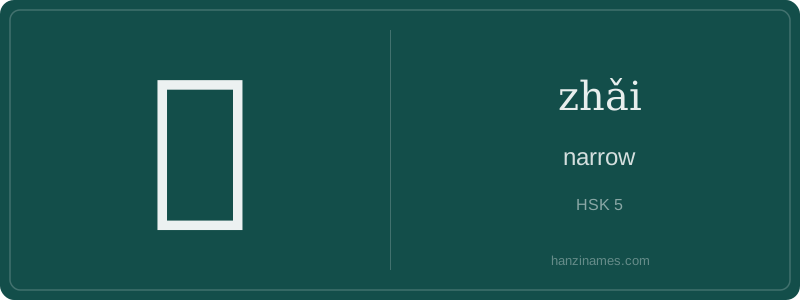
In modern Chinese, 窄 most commonly describes physical constriction: narrow streets (窄巷 zhǎi xiàng), tight clothing (衣服太窄 yīfu tài zhǎi), or limited bandwidth (带宽太窄 dàikuān tài zhǎi). It appears in the HSK 5–6 vocabulary list and frequently in technical, urban, and descriptive contexts. A documented idiom is 心胸狭窄 (xīnxiōng xiázhǎi), meaning 'narrow-minded'—used since at least the Ming dynasty in moral texts like *The Book of Nourishing the Mind* (《养心篇》).
The character is not a pictograph from oracle bones—it first appears in Han-era bamboo slips. Its structure is semantic-phonetic: 穴 (meaning) + 乍 (sound). Today, Chinese speakers use it routinely when complaining about cramped subway cars, narrow doorways in old Shanghai shikumen houses, or narrow profit margins in business reports—real, recurring spatial and metaphorical constraints.
Our detective work begins at the character’s radical: 穴 (xué), meaning 'cave' or 'hole'—a top-component that signals enclosure, confinement, or spatial limitation. This radical appears in characters related to shelter, hiding, or restricted space (e.g., 穷 qióng 'poor', 突 tū 'sudden', 窗 chuāng 'window'). In 窄, it sets the semantic stage: something constrained *within* a bounded space.
The lower component is 乍 (zhà), originally a pictograph of a person standing upright with arms raised—later repurposed as a phonetic element. Though 乍 now means 'suddenly', its ancient pronunciation closely matched early forms of zhǎi, making it a reliable phonetic clue. Over time, sound shifts occurred, but the link remains traceable in Middle Chinese rhyme dictionaries like the *Qieyun* (601 CE).
Tracing seal script (c. 220 BCE) and clerical script (Han dynasty), 窄 consistently features the 'cave' roof over 乍—no radical swaps or structural mutations. Unlike many characters that evolved dramatically, 窄 stabilized early. Its ten-stroke form has remained virtually unchanged since the Tang dynasty, reflecting how precisely its meaning—physical narrowness—lent itself to stable visual encoding.
Example Sentences
Common Compounds
Similar Characters — Don't Mix These Up
Your First Step into Chinese Culture: Get a Chinese Name
Every journey into Chinese begins with a name. Use our free Chinese name generator to create a meaningful, personalized Chinese name that fits you perfectly.
Get My Chinese Name →