粘
Character Story & Explanation
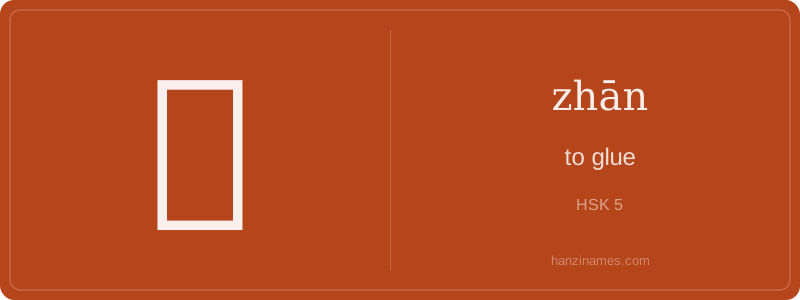
Historically documented since at least the Tang dynasty, 粘 appears in agricultural and craft manuals describing rice-based adhesives for papermaking, bookbinding, and lacquerware repair. In daily life, it’s ubiquitous: people say ‘胶水很粘’ (jiāoshuǐ hěn zhān, ‘glue is very sticky’), warn children ‘别粘墙’ (‘Don’t stick to the wall’), and use 粘 in tech contexts like ‘屏幕太粘’ (‘screen is too sticky from oil’). The idiom ‘粘锅’ (zhān guō, ‘food sticks to the wok’) is a common kitchen lament—and a real culinary challenge tied to heat control and wok seasoning.
The character’s form isn’t pictographic—it evolved from seal script where 米 (rice) and 占 (phonetic) merged by Han dynasty. No oracle bone record exists for 粘; its earliest verified forms appear in Eastern Han steles. So instead: picture a Beijing calligrapher re-inking a brush—dipping into sticky ink paste, then carefully applying characters to rice paper without smudging. That tactile, controlled adhesion? That’s 粘 in action.
Our detective begins at the scene: the character 粘 (zhān), with its 11 strokes and 米 (rice) radical, looks suspiciously edible—but it’s not about food. The 米 radical hints at a historical link to glutinous rice paste, one of ancient China’s earliest natural adhesives. In pre-modern workshops, sticky rice mortar was used in imperial architecture—think Forbidden City walls—where starch-rich rice glue bound bricks tighter than lime alone. This practical, material reality seeded the character’s semantic core: adhesion through viscosity.
Zooming in on the right side, 占 (zhān, 'to occupy; divine') acts as the phonetic component—providing sound, not meaning. But there’s irony: while 占 suggests control or claim, 粘 conveys passive, physical clinging—like syrup on fingers or a stamp stuck to paper. This tension between agency (占) and inevitability (粘) reveals how Chinese characters encode layered logic: sound + function, not just picture + idea.
Modern forensics confirm the character’s consistency: from Song dynasty medical texts prescribing ‘rice-paste plasters’ (米粘膏) to today’s packaging labels warning ‘表面勿粘’ (‘Do not stick to surface’), 粘 has retained its core valence of intentional or accidental adherence. No semantic drift—just evolution in medium: from glutinous rice slurry to synthetic glue, from woodblock printing ink to touchscreen smudges. The character remains sticky in both form and function.
Example Sentences
Common Compounds
Similar Characters — Don't Mix These Up
Your First Step into Chinese Culture: Get a Chinese Name
Every journey into Chinese begins with a name. Use our free Chinese name generator to create a meaningful, personalized Chinese name that fits you perfectly.
Get My Chinese Name →