素
Character Story & Explanation
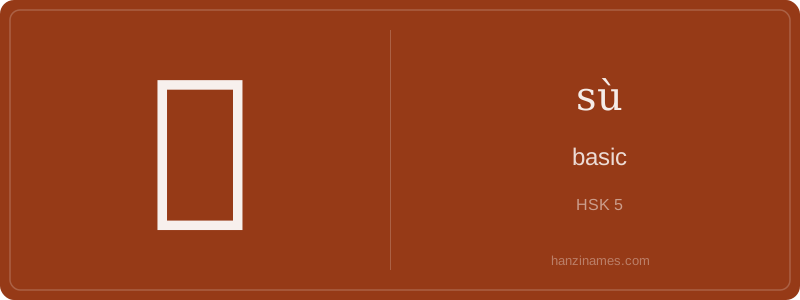
Historically, 素 referred specifically to undyed, unadorned silk — prized in Zhou and Han dynasties for ritual garments and elite textiles. This literal meaning solidified its semantic field: purity, simplicity, and essence. Today, it’s ubiquitous in compound words like 素食 (sùshí, 'vegetarian food'), reflecting Buddhist-influenced dietary customs, and in formal contexts like 教师素质 (jiàoshī sùzhì, 'teacher professional competence'), a key term in China’s education policy documents since the 1990s.
The character’s form has no verified pictographic origin (it’s not a drawing of silk). Instead, it emerged as a phono-semantic compound in early seal script. In daily life, Chinese people most commonly encounter 素 on food packaging ('素' labels for vegetarian products), in school assessments ('综合素质评价' zōnghé sùzhì píngjià, 'comprehensive quality evaluation'), and in health contexts like 素颜 (sùyán, 'bare face' — makeup-free appearance).
Hi students! Let’s explore 素 (sù), a character with deep roots in ancient Chinese material culture. Its original meaning was 'raw, unbleached silk' — not yet dyed or woven into fabric. This idea of 'unprocessed, natural state' became the foundation for all its modern meanings: plain, simple, basic, vegetarian, and even 'elementary' or 'inherent'. Notice how one concrete object (raw silk) evolved into abstract concepts — a beautiful example of how Chinese characters grow semantically over time.
The radical 糸 (sī, 'silk thread') clearly signals its textile origin — you’ll see this radical in many characters related to cloth, weaving, or fine threads (e.g., 红 hóng 'red', 级 jí 'level'). The right side, 厶 (sī), is a phonetic component, hinting at pronunciation. Though it looks like a tiny curl or hook, it’s not pictographic — it’s a standardized sound marker inherited from ancient scripts.
Today, 素 appears everywhere: on restaurant signs saying 素食 (sùshí, 'vegetarian food'), in science terms like 元素 (yuánsù, 'chemical element'), and in moral phrases like 素质 (sùzhì, 'quality' or 'innate quality'). It carries quiet elegance — never flashy, always fundamental. Mastering 素 helps you understand not just vocabulary, but how Chinese thinking values simplicity, authenticity, and foundational truth.
Example Sentences
Common Compounds
Similar Characters — Don't Mix These Up
Your First Step into Chinese Culture: Get a Chinese Name
Every journey into Chinese begins with a name. Use our free Chinese name generator to create a meaningful, personalized Chinese name that fits you perfectly.
Get My Chinese Name →