组
Character Story & Explanation
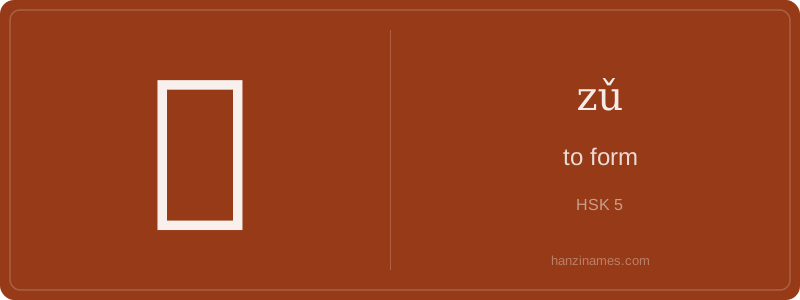
In Shanghai’s Pudong New Area, urban planners use 组 daily in documents like '功能组团规划' (gōngnéng zǔ tuán guīhuà)—'functional group planning'—referring to zoning districts by purpose (residential, commercial, green space). This mirrors national practice: China’s 14th Five-Year Plan (2021–2025) repeatedly uses 组建 (zǔ jiàn, 'to establish/organize') for new innovation consortia, such as the Yangtze River Delta Integrated Development Group. The term 小组 (xiǎo zǔ) appears over 1,200 times in official Xinhua News Agency reports since 2020, denoting grassroots working groups in poverty alleviation and pandemic response.
The character’s origin is documented in the Shuōwén Jiězì (c. 100 CE) as a phono-semantic compound: 纟 (thread) + 主 (master, phonetic). No oracle-bone or bronze inscriptions survive for 组—it first appears in seal script during the Warring States period (475–221 BCE), consistently meaning 'to assemble'. Its modern usage reflects this ancient function: not spontaneous gathering, but deliberate, structured formation.
The character 组 (zǔ) embodies the idea of 'to form' or 'to organize'—a foundational concept in Chinese social and institutional life. With its 纟 (silk/thread) radical, it subtly evokes weaving threads together into a coherent structure, reflecting how people, ideas, or resources are deliberately assembled. This semantic thread runs through everything from classroom groups to national policy teams, emphasizing intentionality and cohesion over randomness.
At HSK Level 5, 组 signals increasing linguistic maturity: learners now handle abstract organizational verbs beyond basic actions. It appears frequently in compound words like 小组 (xiǎo zǔ, 'small group') and 组成 (zǔ chéng, 'to constitute'), where context determines whether it's a verb ('they formed a team') or part of a noun ('the research group'). Mastery requires recognizing its role across syntax layers—not just as standalone action, but as relational glue.
Unlike pictographic characters, 组 is a phono-semantic compound: the right side 主 (zhǔ) provides sound approximation (zǔ ~ zhǔ), while the left 纟 hints at connection—like threads binding elements. Its eight-stroke structure is tidy and balanced, making it a pedagogical anchor for learning compound formation. In daily use, it’s rarely isolated; instead, it thrives in collocations that mirror China’s collectivist ethos—where forming, assigning, and structuring are constant, quiet acts of social maintenance.
Example Sentences
Common Compounds
Similar Characters — Don't Mix These Up
Your First Step into Chinese Culture: Get a Chinese Name
Every journey into Chinese begins with a name. Use our free Chinese name generator to create a meaningful, personalized Chinese name that fits you perfectly.
Get My Chinese Name →