统
Character Story & Explanation
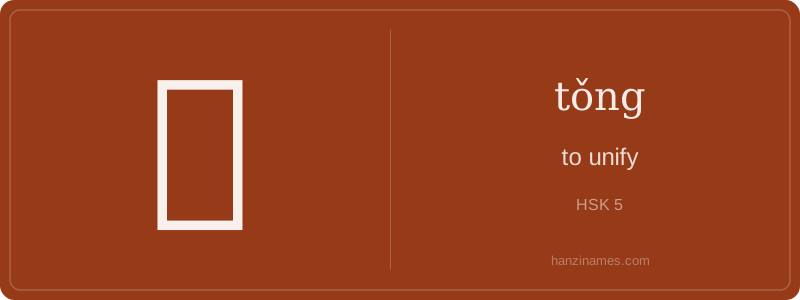
统 is ubiquitous in modern China’s administrative and educational lexicon. It appears in official terms like 统一高考 (tǒngyī gāokǎo, 'National College Entrance Examination') and 统编教材 (tǒngbiān jiàocái, 'state-unified textbooks'), reflecting centralized curriculum standardization since 2017. The idiom 一统天下 (yī tǒng tiānxià) — historically used to describe Qin Shi Huang’s unification of China in 221 BCE — remains politically resonant, appearing in state media to denote national cohesion.
The character’s form evolved from seal script, where 纟 (silk thread) + 充 (chōng, ‘to fill’ or ‘to complete’) suggested ‘filling/organizing threads into a unified skein’. Though not a pictograph, its structure visually reinforces the concept: threads gathered and directed—symbolizing how ancient Chinese administrators ‘gathered’ resources, people, and rites into functional systems.
The character 统 (tǒng) embodies a foundational Chinese worldview: unity through integration, not uniformity. Its core idea of 'to gather' extends beyond physical collection—it signifies harmonizing diverse elements under a coherent principle, like rivers converging into one sea or myriad schools of thought synthesizing into Confucian statecraft. This reflects the classical ideal of 天下大同 (‘great unity under heaven’), where order emerges not from suppression but from inclusive coordination.
In governance and philosophy, 统 conveys authoritative yet organic cohesion—think of the emperor as the ‘unifier’ (统帅) who aligns military, ritual, and civil administration without erasing regional distinctions. Unlike Western notions of central control, 统 implies relational wholeness: threads (the 纟 radical) woven into fabric, each essential to the integrity of the whole. It’s less about domination and more about resonance and alignment.
This worldview permeates language use: 统 is rarely about brute force but about systemic coherence—standardizing measurements (统一), integrating data (统筹), or unifying education (统编教材). Even in modern tech, ‘system integration’ is 系统整合, but ‘unified platform’ is 统一平台. The character thus encodes a civilizational preference: harmony arises when diversity is gathered—not flattened—into purposeful unity, mirroring Daoist balance and Confucian relational ethics.
Example Sentences
Common Compounds
Similar Characters — Don't Mix These Up
Your First Step into Chinese Culture: Get a Chinese Name
Every journey into Chinese begins with a name. Use our free Chinese name generator to create a meaningful, personalized Chinese name that fits you perfectly.
Get My Chinese Name →