综
Character Story & Explanation
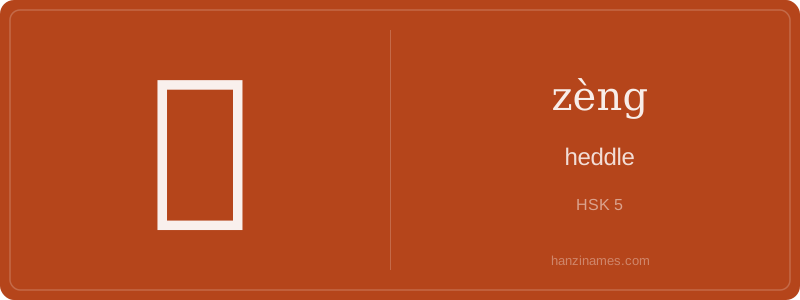
In modern Chinese usage, 综 appears almost exclusively in compound words meaning 'comprehensive', 'integrated', or 'synthetic'—especially in formal, academic, and bureaucratic contexts. It is central to HSK 5 vocabulary via terms like 综合 (zōnghé, 'comprehensive'), 综述 (zōnshù, 'summary/review article'), and 综合素质 (zōnghé sùzhì, 'comprehensive quality', a key education policy term). Historically, it appears in Song–Ming dynasty technical texts on sericulture, such as the 17th-century *Tiangong Kaiwu* (‘Exploitation of the Works of Nature’), which details heddle construction for silk looms.
The character’s form derives from 纟 (silk/thread radical) + 宗 (zōng, 'ancestral temple; origin'), indicating 'the fundamental thread-organizing element'. This is a phono-semantic compound: 宗 provides pronunciation and conveys 'core function', while 纟 specifies domain. No oracle-bone or bronze inscriptions of 综 survive; its earliest attested forms appear in Han dynasty bamboo slips related to textile regulation.
The Chinese character 综 (zōng, not zèng—note: zèng is a rare, archaic reading; the standard modern pronunciation is zōng) represents a key component in traditional Chinese loom technology: the heddle. A heddle is a looped cord or wire that separates warp threads to allow the weft to pass through during weaving—a foundational mechanism in textile production across ancient civilizations. In China, this device was integral to silk weaving, one of the country’s most historically significant crafts and export commodities.
Unlike Western looms that often used rigid harnesses or foot-treadle systems, early Chinese looms employed bamboo or silk-thread heddles manipulated by hand or simple levers—making 综 both a technical term and a symbol of precision and interlacing. The character’s radical 纟 (silk/thread) directly signals its textile origin, anchoring it in material culture rather than abstract semantics. Its use extends metaphorically to 'comprehensive' or 'synthetic' thinking—reflecting how heddles coordinate disparate threads into unified fabric.
This duality—concrete tool and abstract concept—is mirrored in Western equivalents like the Latin *telum* (loom) or Greek *histos* (warp), which also evolved into words for 'structure' and 'system'. Yet 综 uniquely retains its technical root in modern Standard Mandarin: it appears in academic and administrative contexts (e.g., 综合, zōnghé, 'comprehensive') precisely because weaving metaphors for integration are deeply embedded in Chinese epistemology—much as 'weave' and 'fabric' function metaphorically in English, but with far greater lexical continuity in Chinese.
Example Sentences
Common Compounds
Similar Characters — Don't Mix These Up
Your First Step into Chinese Culture: Get a Chinese Name
Every journey into Chinese begins with a name. Use our free Chinese name generator to create a meaningful, personalized Chinese name that fits you perfectly.
Get My Chinese Name →