绪
Character Story & Explanation
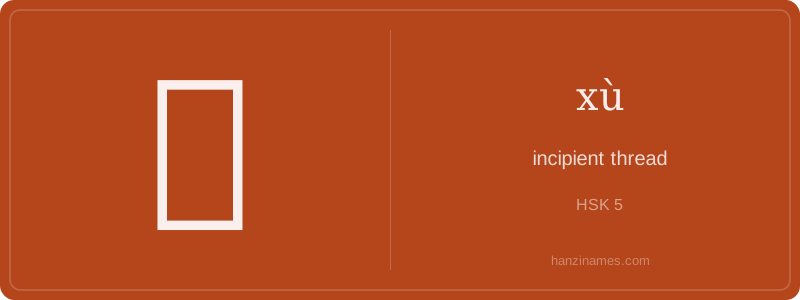
In daily life, 绪 most commonly appears in formal or literary contexts—not casual speech. It's indispensable in fixed expressions like 情绪 (qíngxù, 'emotion/mood'), 意绪 (yìxù, 'melancholy or reflective mood'), and 纲绪 (gāngxù, 'main thread or guiding principle'). The HSK 5 textbook series uses it in reading passages about historical continuity and scholarly tradition. Historically, it appears over 200 times in the 17th-century encyclopedic work Gujin Tushu Jicheng, always denoting 'foundational elements' or 'incipient patterns' in governance or ethics.
The character’s written form has no pictographic origin—it’s a later Han dynasty creation. Its left side 纟 is the simplified form of 糸 (sī), meaning 'silk thread', reflecting its semantic field of continuity and linkage. The right side 者 (zhě) serves phonetically but also subtly evokes 'one who initiates', reinforcing its association with origination—not as a moment, but as a delicate, traceable strand.
As a detective tracing 绪’s evolution, I begin at the crime scene: the Shuōwén Jiězì (121 CE), where it first appears as a phonosemantic compound—radical 纟 (silk thread) + phonetic 者 (zhě). The radical signals association with threads—literal and metaphorical—hinting at continuity, connection, and origin. Early usage centered on 'thread ends' or 'loose strands', evolving into abstract 'beginnings' or 'traces' of something emerging.
The character never appeared in oracle bone or bronze inscriptions; its documented life starts in Han dynasty lexicography. Its phonetic component 者 originally carried connotations of 'one who…', lending an agentive nuance—'that which begins' or 'the nascent aspect'. Over centuries, scholars like Kong Yingda (Tang) and Zhu Xi (Song) used 绪 in classical commentary to denote 'founding principles'—e.g., the 'initial thread' of moral cultivation in Confucian texts.
By the Ming–Qing period, 绪 entered vernacular literature not as a standalone noun but embedded in compounds like 情绪 (emotional state) and 纲绪 (guiding thread of principle). Crucially, it never meant 'beginning' in the sense of a discrete event (like 开始 kāishǐ), but rather the fragile, filamentous *first sign*—a whisper before the shout, a tremor before the earthquake. This subtlety persists in modern usage: 绪 is always about emergence-in-process, never arrival.
Example Sentences
Common Compounds
Similar Characters — Don't Mix These Up
Your First Step into Chinese Culture: Get a Chinese Name
Every journey into Chinese begins with a name. Use our free Chinese name generator to create a meaningful, personalized Chinese name that fits you perfectly.
Get My Chinese Name →