缓
Character Story & Explanation
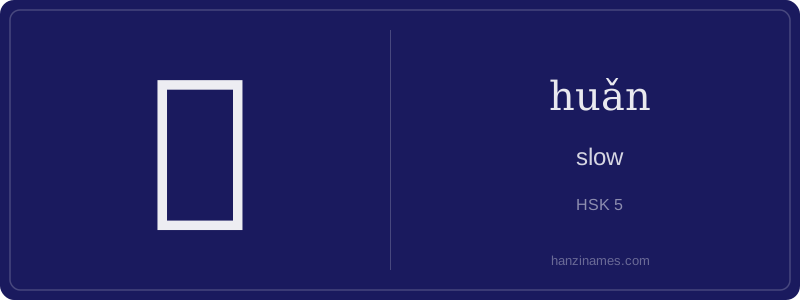
In contemporary China, 缓 appears frequently in official discourse and daily speech — especially in phrases like 缓解 (huǎnjiě, 'alleviate'), 缓冲 (huǎnchōng, 'buffer'), and 缓刑 (huǎnxíng, 'suspended sentence'). It’s central to national policy language: China’s 'dual carbon' goals emphasize 缓慢转型 (gradual transition) rather than abrupt change. The idiom 欲速则不达 (‘haste makes waste’) reinforces 缓’s philosophical weight, appearing in textbooks since the Ming dynasty.
The character 缓 evolved from seal script, where its right side (爰) served phonetic function, while the left 纟 (silk radical) signaled association with flexibility and continuity — consistent with ancient textile metaphors for social harmony. No oracle bone form survives, but its earliest verified use appears in Han dynasty medical texts describing gradual therapeutic effects.
The character 缓 (huǎn) embodies the gentle, intentional slowness valued in Chinese philosophy and daily life — not as laziness, but as mindful pacing. In traditional medicine, 'huǎn' describes treatments that gradually restore balance; in calligraphy, a 'huǎn stroke' flows with controlled rhythm. Its silk-thread radical (纟) hints at elasticity and resilience — like a stretched thread that yields without breaking, symbolizing adaptable patience.
Modern urban Chinese often invoke 缓 when resisting relentless speed: a teacher tells students to '缓一缓' (take a breath) before exams; a city planner advocates '缓建' (phased construction) to preserve neighborhood character. This reflects Confucian and Daoist ideals where restraint and timing ('shi') matter more than haste — making 缓 both linguistic tool and cultural compass.
Unlike English ‘slow’, which can carry negative connotations, 缓 is inherently neutral-to-positive in Chinese — it implies wisdom, care, and sustainability. You’ll hear it in public health campaigns ('缓解压力' — relieve stress), environmental policy ('放缓碳排放增长' — slow carbon emission growth), and even tech interfaces ('缓存' — cache, literally 'slow storage'). Its twelve-stroke structure mirrors this layered meaning: deliberate, balanced, and deeply functional.
Example Sentences
Common Compounds
Similar Characters — Don't Mix These Up
Your First Step into Chinese Culture: Get a Chinese Name
Every journey into Chinese begins with a name. Use our free Chinese name generator to create a meaningful, personalized Chinese name that fits you perfectly.
Get My Chinese Name →