县
Character Story & Explanation
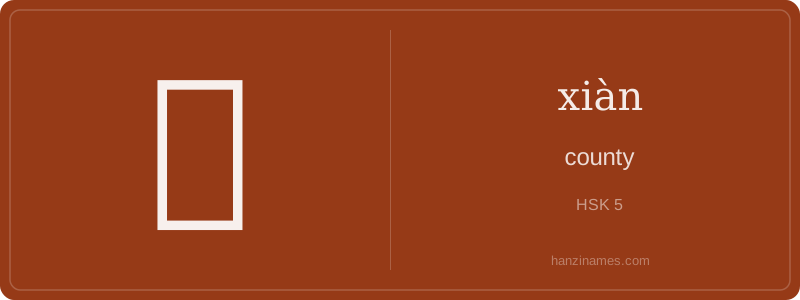
县 has been an official administrative unit in China since the Qin Dynasty (221–206 BCE), when centralized bureaucracy replaced feudal states. Today, it remains one of China’s primary county-level divisions (alongside district-level cities and autonomous counties), governed by prefecture-level cities. You’ll encounter it in headlines like ‘County-level poverty alleviation completed’ or in travel guides listing scenic spots such as ‘Zhangjiajie National Forest Park, Sangzhi County’. Common phrases include 县政府 (xiàn zhèngfǔ, county government) and 县城 (xiànchéng, county seat — the main town of a county).
The character’s earliest attested form appears in seal script (c. 3rd century BCE), showing a simplified representation of a walled settlement with a marker for authority. While its exact pictographic origin isn’t preserved in oracle bones, the modern structure combines 厶 (a variant of 台, suggesting a platform or seat of power) and 口 (enclosure, symbolizing jurisdiction). In practice, Chinese people use 县 daily when filling out forms, checking ID cards (which list hometown county), or discussing regional development policies.
Hello, learners! The character 县 (xiàn) means 'county' — a key administrative division in China, smaller than a province but larger than a town. It’s pronounced with the fourth tone: xiàn (like 'shee-AN' with a falling pitch). Though it looks simple (just 7 strokes), its meaning carries real-world weight: over 2,800 counties exist across mainland China today, each with its own government, schools, and local identity. Don’t confuse it with cities or provinces — counties are rural or semi-urban hubs where many Chinese families live and register their household registration (hùkǒu).
As an HSK Level 5 character, 县 appears in formal and geographic contexts — not daily small talk, but essential for reading news, maps, or official documents. You’ll see it in names like ‘Shanxi Province’ (山西省) or ‘Tonglu County’ (桐庐县). Its radical 厶 (sī) is a small, closed shape often linked to secrecy or enclosure — historically hinting at a bounded, self-governed area. Mastering this character helps you understand China’s layered governance system.
Writing 县 correctly matters: stroke order starts with the dot (丶), then the left-falling stroke (丿), followed by the three horizontal strokes forming the top, and finally the bottom ‘mouth’-like component (口). Practicing slowly builds muscle memory — try tracing it while saying ‘xiàn’ aloud. Since counties are foundational to China’s civil administration, recognizing 县 unlocks comprehension of place names, policy reports, and even family origins (e.g., ‘I’m from Lishui County’). It’s a quiet but powerful word — one that roots language in real geography and history.
Example Sentences
Common Compounds
Similar Characters — Don't Mix These Up
Your First Step into Chinese Culture: Get a Chinese Name
Every journey into Chinese begins with a name. Use our free Chinese name generator to create a meaningful, personalized Chinese name that fits you perfectly.
Get My Chinese Name →