织
Character Story & Explanation
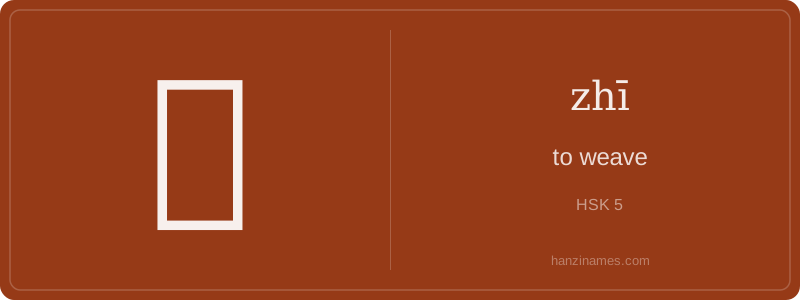
织 appears in daily life across contexts: in textile manufacturing (织布机 'weaving machine'), digital metaphors (编织网络 'to weave a network'), and idioms like 编织梦想 ('to weave dreams'), widely used in education and media. Historically, it features in the Tang-era *Tongdian* as a tax category—households paid tribute in bolts of woven cloth. It remains central in HSK-5 vocabulary for expressing creation, connection, and intentional construction.
The character evolved from bronze inscriptions where 纟 (silk radical) combined with 只 (a phonetic borrowed for its zhī sound). No oracle-bone form survives, but Shuowen Jiezi (121 CE) defines it as 'interlacing threads'—a functional description confirmed by archaeological textile remains. Today, Chinese learners encounter it most often in compound verbs like 织毛衣 ('to knit a sweater') or metaphorical phrases like 织就人生 ('to weave one’s life').
As an archaeologist brushing dust from a Han dynasty silk fragment, I find 织 etched in bamboo slips describing imperial textile workshops—its 纟 (silk) radical not merely decorative but documentary evidence of China’s 5,000-year sericulture legacy. The eight strokes encode labor: first the thread (纟), then the rhythmic motion of shuttle and loom—each stroke a measured pass through warp and weft. This is no abstract verb; it is embodied craft, preserved in ink and fiber.
Excavations at Mawangdui revealed 2,100-year-old brocades bearing inscriptions with 织—proof that its meaning extended beyond action to status: 'woven by royal command' signaled rank, taxation, and tribute. The character appears in administrative texts listing weavers’ quotas, confirming its bureaucratic weight. Its phonetic component 只 (zhī) was likely chosen for sound rather than sense—a common practice in phono-semantic compounds—and tells us scribes prioritized audibility over pictorial logic when standardizing script.
Unlike later simplified forms, early seal-script 织 (circa 3rd c. BCE) shows unmistakable loom imagery: vertical threads anchored, horizontal weft inserted. Though the modern form abstracts these lines, calligraphers still trace the rhythm of weaving in its stroke order—starting with the left-falling thread stroke (丶), then the looping tension of the second (), mirroring how warp threads are stretched before interlacing. Every repetition of this character is a quiet reenactment of ancient industry.
Example Sentences
Common Compounds
Similar Characters — Don't Mix These Up
Your First Step into Chinese Culture: Get a Chinese Name
Every journey into Chinese begins with a name. Use our free Chinese name generator to create a meaningful, personalized Chinese name that fits you perfectly.
Get My Chinese Name →