翅
Character Story & Explanation
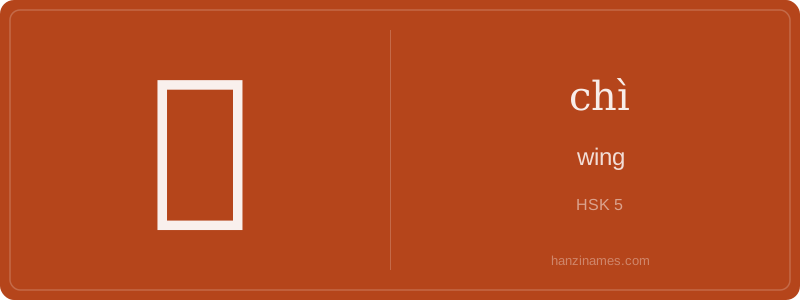
In modern Chinese, 翅 appears most frequently in compounds like 翅膀 (chìbǎng, 'wing') and in culinary contexts—especially 炸鸡翅 (zhá jī chì, 'fried chicken wings'), a ubiquitous menu item documented in post-1980s restaurant menus and China’s first fast-food chains. It also features in idioms such as 如虎添翼 (rú hǔ tiān yì, 'like adding wings to a tiger'), attested in Ming-dynasty novels like *Journey to the West* and still used today to describe decisive advantage.
The character is not pictographic in origin—it evolved from seal script where the left side clearly depicts feathers (羽), and the right side 支 served as a phonetic loan. No oracle bone or bronze inscription uses 翅 independently; its earliest secure attestations are in Warring States bamboo texts (c. 475–221 BCE), always in functional biological or metaphorical contexts.
Unearthing 翅 (chì) feels like brushing dust from a Han dynasty lacquerware bird motif—its form still humming with aerodynamic intent. The radical 羽 (yǔ, 'feather') anchors it firmly in the avian realm, while the phonetic component 支 (zhī, 'to support') subtly hints at structural function: not just ornament, but apparatus of lift and motion. This is no static pictograph; it’s a functional glyph, refined over centuries to encode biomechanical truth.
Archaeological inscriptions show 翅 rarely appears alone in early texts—it emerges fully formed in Warring States bamboo slips as part of compound terms like 翅膀 (chìbǎng), already meaning 'wing' with anatomical precision. Its 10-stroke structure stabilizes across script evolutions: from clerical to regular script, the two feather strokes on the left remain unmistakably kinetic, like wingtips mid-beat.
Unlike mythical characters born from oracle-bone divination, 翅 bears the quiet authority of empirical observation. It reflects ancient Chinese ornithology—not mystical symbolism, but careful study of flight mechanics evident in bronze vessel engravings and silk-painting cranes. Its endurance speaks to utility: when you name the thing that lets birds cross mountains and kites catch wind, you carve a word that lasts millennia.
Example Sentences
Common Compounds
Similar Characters — Don't Mix These Up
Your First Step into Chinese Culture: Get a Chinese Name
Every journey into Chinese begins with a name. Use our free Chinese name generator to create a meaningful, personalized Chinese name that fits you perfectly.
Get My Chinese Name →