西
Character Story & Explanation
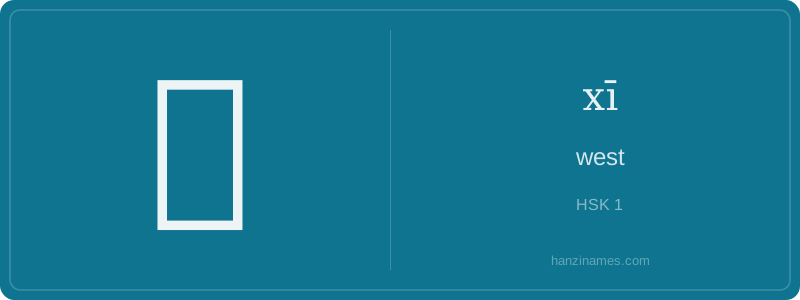
In daily life, 西 appears ubiquitously: street names (e.g., 西安路 Xī’ān Lù), subway lines (Line 2’s ‘West Extension’), weather reports (‘northwest wind’), and even coffee shop menus (‘western-style breakfast’). Historically, it anchored China’s cardinal system — used in the *Rites of Zhou* to designate western gates, military banners, and ritual offerings. A well-documented idiom is 东张西望 (dōng zhāng xī wàng), meaning ‘to look around distractedly’, attested since the Ming dynasty in vernacular fiction like *Jin Ping Mei*.
The character’s earliest verified form is in Western Zhōu bronze inscriptions (~10th c. BCE), where it appears as a balanced, box-like glyph with internal strokes. Modern scholarship rejects the myth that it depicts ‘the setting sun’; rather, it likely originated as a phonetic loan for xī, possibly borrowing the shape of an ancient word for ‘nest’ (also pronounced xī), later repurposed for direction due to sound correspondence.
As a detective tracing 西 (xī), I begin at the Shāng dynasty oracle bones — but here’s the twist: no confirmed oracle-bone form of 西 survives. The earliest secure attestation appears in Western Zhōu bronze inscriptions (c. 1000 BCE), where it already resembles its modern shape — a symmetrical, enclosed frame with internal strokes. Scholars like Karlgren and Li Xiaoding note it was likely borrowed as a phonetic loan for ‘west’, originally picturing a *nest* or *bird’s roost* (a homophone of xī in Old Chinese), not a compass direction.
This character never evolved from a sun-or-mountain pictograph — a common misconception. Instead, its six-stroke structure stabilized remarkably early: two verticals framing three horizontal bars and a central dot or short stroke. Unlike characters that simplified dramatically, 西 retained near-identical form from bronze script through seal, clerical, and standard script. Its radical status is tautological: 西 is its own radical — one of only a handful (like 水, 木) that serve both as independent characters and foundational components.
The detective’s conclusion? 西 is a linguistic fossil — not a picture of the West, but a sound-based placeholder that outlived its original meaning. Its enduring symmetry (two verticals, three horizontals, one dot) made it easy to write, hard to misread, and ideal for directional labeling in imperial cartography and palace architecture. By the Hàn dynasty, it was unambiguously ‘west’ in texts like the *Shuōwén Jiězì*, which classifies it under ‘Western direction’ — cementing its semantic role despite its non-pictorial origin.
Example Sentences
Common Compounds
Similar Characters — Don't Mix These Up
Your First Step into Chinese Culture: Get a Chinese Name
Every journey into Chinese begins with a name. Use our free Chinese name generator to create a meaningful, personalized Chinese name that fits you perfectly.
Get My Chinese Name →