腰
Character Story & Explanation
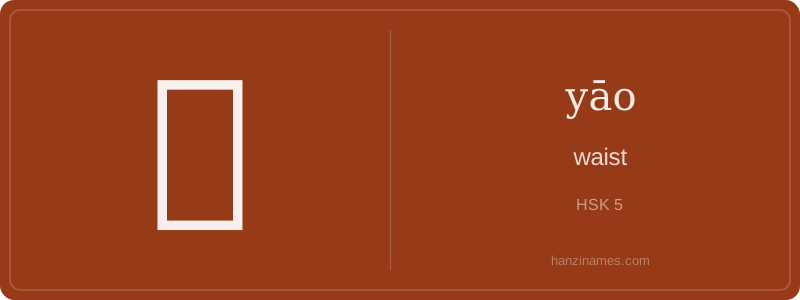
腰 is deeply embedded in daily Chinese life: used in health warnings ('保护好你的腰'—'Protect your waist'), martial arts commands ('沉腰坐马'—'sink the waist, ride the horse stance'), and idioms like 腰缠万贯 ('waist bound with ten thousand strings of cash'), meaning 'extremely wealthy'—a vivid reference to ancient merchants carrying money around their waists. It appears in HSK 5 vocabulary lists and modern textbooks as a core term for body parts and posture.
The character is not pictographic. Its form combines the flesh radical ⺼ (indicating body-related meaning) with the phonetic 要 (yāo), which also carries the sense of 'essential' or 'crucial'. This reflects its functional importance—not as a visual depiction, but as a conceptual anchor: the waist is literally the 'essential part' of the body’s structure and energy flow.
As an archaeologist brushing dust from a Han dynasty medical bamboo slip, I found 腰 etched beside diagrams of the human torso—labeled not just as anatomy but as a vital nexus: where the kidney qi anchors, where martial artists pivot, and where classical poets measured grace. Its radical ⺼ (flesh/body) signals corporeal reality, while the phonetic component 要 (yāo) hints at centrality—literally 'the essential part' of the body’s architecture.
This character emerged fully formed in seal script (c. 3rd century BCE), already bearing its dual anatomical and metaphorical weight. Unlike many characters that evolved from pictographs, 腰 shows no early bone or oracle-bone depictions of the waist itself; instead, it crystallized as a semantic-phonetic compound during standardization under Qin rule—a deliberate lexical choice to name a functional, culturally loaded zone of the body.
In Tang medical texts like the *Qian Jin Yao Fang*, 腰 appears over 200 times—not merely as location, but as diagnostic locus: 'weak waist' signaled kidney deficiency, 'cold waist' implied stagnation. Even today, TCM practitioners palpate the lumbar region while reciting formulas containing 腰, preserving a 1,300-year continuity of embodied knowledge encoded in this single character.
Example Sentences
Common Compounds
Similar Characters — Don't Mix These Up
Your First Step into Chinese Culture: Get a Chinese Name
Every journey into Chinese begins with a name. Use our free Chinese name generator to create a meaningful, personalized Chinese name that fits you perfectly.
Get My Chinese Name →