胶
Character Story & Explanation
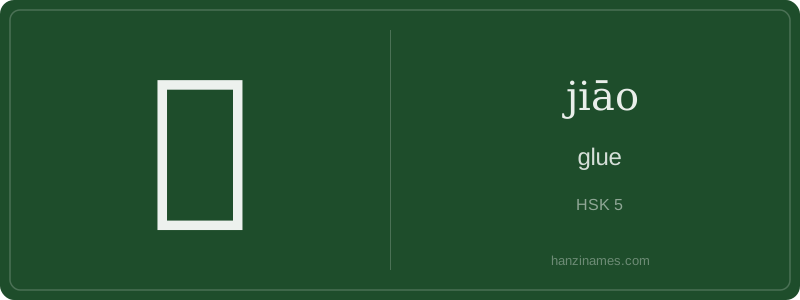
胶 is widely used today in daily life: ‘胶水’ (jiāoshuǐ, glue) appears on school supplies, DIY kits, and factory labels across China. It features in the common phrase ‘胶着状态’ (jiāozhuó zhuàngtài), meaning ‘stalemate’ or ‘deadlock’ — borrowed from military terminology where forces become ‘stuck like glue’. Historically, gelatinous glue from donkey hide (‘阿胶’, ājiāo) has been prescribed since the Han dynasty for blood deficiency, as recorded in the *Shennong Ben Cao Jing*.
The character’s form is not pictographic but phono-semantic: ⺼ (flesh radical) indicates origin from animal tissue, while 交 (jiāo) provides pronunciation and hints at ‘joining’. No oracle-bone or bronze inscriptions survive for 胶 — its earliest confirmed appearance is in Han-era bamboo slips and medical manuscripts.
Our detective begins at the crime scene: the character 胡 (hú) — no, wait — that’s a red herring. Focus shifts to ⺼ (the ‘flesh’ radical), which appears on the left. But 胶 isn’t about flesh — it’s about *substance* derived from animal tissue. Historically, traditional Chinese glue was made by boiling collagen-rich animal parts like tendons and hides. So ⺼ here signals origin: organic, bodily material. The right side, 交 (jiāo), is both phonetic (matching the pronunciation) and semantic — ‘to intersect’, ‘to join’, hinting at bonding action.
The character’s 10-stroke structure reveals disciplined evolution: early seal script forms already combined ⺼ and 交, confirming its functional duality — sound + source + meaning. Unlike purely pictographic characters, 胶 is a phono-semantic compound, refined over centuries in medical texts (e.g., *Bencao Gangmu*) and craft manuals. Its stability across scripts — from clerical to regular — reflects its practical indispensability in binding, repairing, and even ink-making.
Modern usage has expanded beyond animal glue: synthetic adhesives, industrial resins, and even metaphorical ‘bonding’ (e.g., social glue). Yet the radical ⺼ remains — a quiet testament to its biological roots. This isn’t etymological folklore; it’s documented in Song-dynasty pharmacopeias and Ming-era carpentry treatises. Every stroke anchors us to a material history where glue meant survival — sealing scrolls, mending ceramics, assembling furniture, and even crafting musical instruments like the guqin.
Example Sentences
Common Compounds
Similar Characters — Don't Mix These Up
Your First Step into Chinese Culture: Get a Chinese Name
Every journey into Chinese begins with a name. Use our free Chinese name generator to create a meaningful, personalized Chinese name that fits you perfectly.
Get My Chinese Name →