英
Character Story & Explanation
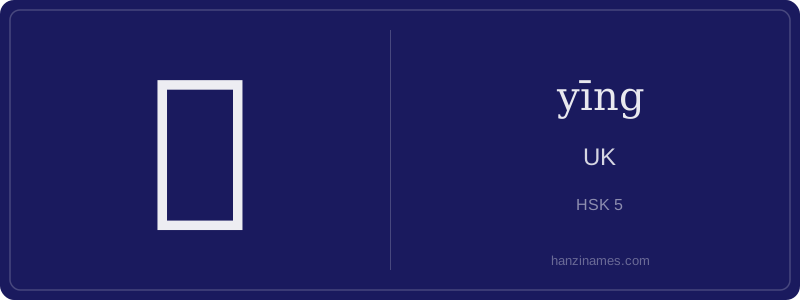
In modern Chinese, 英 appears almost exclusively in proper nouns referring to the UK: 英国 (Yīngguó, 'United Kingdom'), 英语 (Yīngyǔ, 'English language'), and 英镑 (Yīngbàng, 'British pound'). It’s rarely used independently in daily speech with its archaic meaning ('flower' or 'hero')—though it survives in literary or formal compounds like 英雄 (yīngxióng, 'hero') and 英才 (yīngcái, 'outstanding talent'). The term 英国 first appeared widely in official Qing documents after the 1842 Treaty of Nanjing, replacing earlier variants like 英吉利 (Yīngjílì), a fuller phonetic rendering.
Historically, 英 is not a pictograph—it evolved from seal script forms where the top 艹 (grass radical) originally represented 'flowers' or 'brilliance,' and the bottom 央 (yāng) served as a phonetic component. While its earliest oracle-bone or bronze inscriptions are unattested, by the Han dynasty, 英 consistently meant 'flower calyx' or 'excellence' in texts like the *Shuōwén Jiězì* (121 CE). Today, Chinese students learn it as part of HSK 5 vocabulary, mainly through 英国 and 英语—making it one of the most geopolitically consequential characters at that level.
The character 英 (yīng) opens a window into how Chinese conceptualizes foreign nations—not through phonetic imitation alone, but through layered cultural semantics. Though now primarily associated with the United Kingdom (as in 英国, Yīngguó), its original meaning was 'flower,' 'blossom,' or 'outstanding person'—a metaphor for excellence and brilliance. This semantic evolution reflects China’s historical practice of assigning morally resonant, aspirational characters to foreign polities, transforming geopolitical names into value-laden terms.
Unlike direct transliterations (e.g., 美国 for USA, from 'Mei-guo'), 英国 was chosen in the 19th century to render 'England'—not for sound alone, but because 英 carried connotations of heroism, talent, and refinement. Early Qing-era diplomats and translators deliberately selected characters that aligned with Confucian ideals: a nation worthy of respect should bear a name evoking virtue and distinction. Thus, naming becomes an act of diplomatic framing, not mere transcription.
This worldview reveals a deeper linguistic philosophy: language is ethically charged. To call Britain 英国 is to acknowledge its historical influence while embedding it within a Chinese moral lexicon—where even foreign entities are interpreted through indigenous categories of excellence. It exemplifies what scholar Victor Mair calls 'semantic translation': prioritizing cultural resonance over phonetic fidelity. In this light, 英 is less a label and more a lens—refracting Western power through East Asian values of merit, elegance, and cultivated superiority.
Example Sentences
Common Compounds
Similar Characters — Don't Mix These Up
Your First Step into Chinese Culture: Get a Chinese Name
Every journey into Chinese begins with a name. Use our free Chinese name generator to create a meaningful, personalized Chinese name that fits you perfectly.
Get My Chinese Name →