亏
Character Story & Explanation
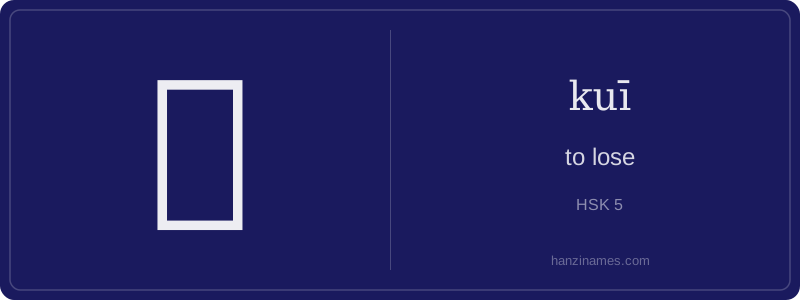
In Shanghai’s bustling Yuyuan Market, vendors shout '不亏!不亏!' (bù kuī! bù kuī!)—'No loss! No loss!'—to assure customers their prices are fair and transparent. This phrase reflects 亏’s deep integration into Chinese commercial culture: it appears in annual reports (e.g., '公司亏损'—the company incurred a loss), tax forms, and the HSK 5 exam’s business vocabulary. Common idioms include '亏本买卖' (kuī běn mǎi mài, a money-losing venture) and '亏心事' (kuī xīn shì, a morally compromising act).
The character’s earliest attested form appears in Qin bamboo slips (c. 3rd century BCE) as a simplified variant of 于, evolving by the Han dynasty to specifically mean 'deficit' or 'failure to fulfill'. It is not pictographic; no oracle bone form survives. Its three-stroke structure stabilized early—making it one of the simplest yet most consequential characters in economic and ethical discourse.
The character 亏 (kuī) visually conveys imbalance—its three strokes form a broken horizontal line above two parallel horizontals, echoing the idea of something missing or falling short. In modern usage, it’s central to financial and moral discourse: from corporate balance sheets to everyday expressions like '亏了' (I lost money), it signals tangible loss or ethical shortfall. Its minimal stroke count belies its conceptual weight—it appears in formal reports, stock market alerts, and even social media complaints about bad deals.
Historically, 亏 emerged in early seal script as a variant of 于, later specializing to denote deficiency. By the Han dynasty, it was standard in fiscal records and philosophical texts like the Xunzi, where it described moral inadequacy ('亏德'—to fall short of virtue). Unlike characters for abstract loss (e.g., 失), 亏 implies measurable, often quantifiable deficit—money, time, reputation, or duty.
Its radical 二 (two) isn’t semantic but structural—it anchors the character’s top-heavy shape, reinforcing visual asymmetry. Though not a true semantic component, this radical subtly echoes duality: gain vs. loss, expectation vs. reality. Learners should note that 亏 rarely stands alone; it thrives in compounds like 亏损 (loss) or 亏欠 (to owe), always carrying a tone of accountability—not just misfortune, but a deficit requiring redress.
Example Sentences
Common Compounds
Similar Characters — Don't Mix These Up
Your First Step into Chinese Culture: Get a Chinese Name
Every journey into Chinese begins with a name. Use our free Chinese name generator to create a meaningful, personalized Chinese name that fits you perfectly.
Get My Chinese Name →