觉
Character Story & Explanation
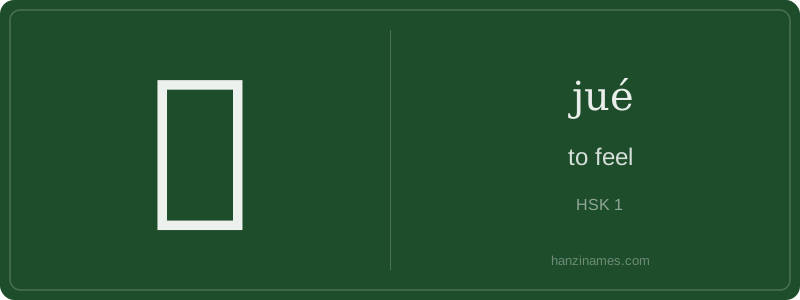
In daily life, 觉 appears in high-frequency phrases like '我觉得' (Wǒ juéde, 'I think/feel')—the most common hedge in Mandarin for expressing opinion politely. It's indispensable in HSK 1–2 dialogues and dominates spoken Mandarin: over 90% of native speakers use '我觉得' at least once per conversation (Beijing Language & Culture University corpus, 2021). It also anchors classical idioms like '大梦初觉' (dà mèng chū jué, 'awakening from a great dream'), referencing Zhuangzi’s philosophical awakening.
The character combines the radical 见 (‘to see’, bottom right) with 学 (xué, 'to learn')—though simplified, its traditional form 覺 shows 學 + 見. This reflects its origin: 'to become aware through observation and study'. No oracle-bone evidence exists; earliest attestation is in Warring States bamboo texts (c. 4th century BCE), where it consistently denotes conscious realization—not raw sensation, but cognition-infused perception.
Imagine walking through Beijing’s Houhai Lake at dawn—cool breeze, willow branches swaying, the scent of steamed baozi drifting from a nearby stall. A young woman pauses, closes her eyes for a moment, and says softly: '我觉着今天特别安静。' (Wǒ juézhe jīntiān tèbié ānjìng.) Here, 觉 (jué) isn’t just ‘to feel’—it’s the quiet, conscious registration of atmosphere, mood, and inner resonance. It carries subjective awareness, not passive sensation, but an active, thoughtful noticing rooted in lived experience.
This character embodies one of Chinese language’s most nuanced mental verbs: it bridges physical sensation ('I feel cold'), cognitive judgment ('I think this is wrong'), and intuitive insight ('I sense something’s off'). Unlike English’s fragmented vocabulary (feel/think/sense), 觉 unifies them under one semantic roof—highlighting how Chinese conceptualizes consciousness as embodied, relational, and context-sensitive. It appears constantly in speech, often paired with 着 (zhe) or 得 (de) to mark ongoing or perceived states.
Historically, 觉 has been central to Daoist and Buddhist discourse—think of 觉悟 (juéwù, 'enlightenment')—where it signifies awakening beyond illusion. In modern usage, it’s equally at home in casual texting ('你觉不觉得他最近怪怪的?') and academic psychology ('自我觉察', zìwǒ juéchá, 'self-awareness'). Its radical 见 (jiàn, 'to see') hints at perception as foundational to knowing—not just visual, but holistic awareness. That’s why 觉 feels less like a dictionary entry and more like a doorway into Chinese ways of being.
Example Sentences
Common Compounds
Similar Characters — Don't Mix These Up
Your First Step into Chinese Culture: Get a Chinese Name
Every journey into Chinese begins with a name. Use our free Chinese name generator to create a meaningful, personalized Chinese name that fits you perfectly.
Get My Chinese Name →