蜂
Character Story & Explanation
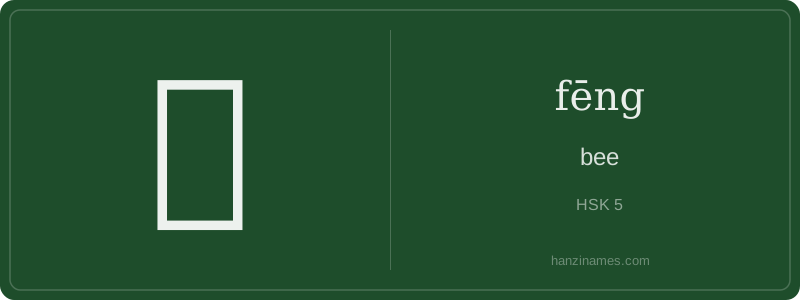
In daily life, 蜂 appears most frequently in compounds like 蜂蜜 (fēngmì, 'honey'), 蜂窝 (fēngwō, 'honeycomb' or 'cellular network'), and idioms such as 蜂拥而至 (fēngyōng ér zhì, 'to swarm in')—a phrase used in news reports about crowds, protests, or viral trends. Historically, bees were vital to traditional Chinese apiculture; the 11th-century agricultural manual *Chen Fu Nong Shu* details hive management and honey harvesting techniques.
The character is not pictographic—it evolved from seal script where 虫 (insect) + 風 (wind) formed a phono-semantic compound. Though 風 contributed pronunciation (fēng), its meaning ('wind') reinforced the bee’s rapid movement. No oracle bone form exists; earliest attestation is in Warring States bamboo texts circa 4th century BCE.
Unearthing 蜂 (fēng) feels like brushing dust from a Han dynasty lacquer box—its form reveals not myth, but meticulous observation. The left radical 虫 (insect) anchors it in the biological realm, while the right component 風 (fēng, 'wind') is not accidental: ancient scribes noted bees’ swift, humming flight—'wind-born creatures' that pollinate imperial orchards and appear in bamboo-strip pharmacopeias as early as the Warring States period.
This character’s 13-stroke composition reflects Classical Chinese precision: every stroke served taxonomy. Unlike poetic loan characters, 蜂 was functional—from tax records listing honey tributes to Tang medical texts prescribing bee venom for rheumatism. Its HSK-5 placement signals not rarity, but semantic density: it appears in compound words requiring conceptual fluency, not just recognition.
Archaeologically, 蜂 carries no oracle-bone inscriptions—it emerged later, in seal script during the Qin unification. Yet its stability across 2,200 years speaks volumes: no radical shift, no phonetic drift. It resisted simplification (unlike 風 → 风), preserving its dual identity—both zoological term and metaphor for industriousness. To write 蜂 is to hold a fossilized cultural contract: humans and bees have co-evolved, documented in ink, not just hives.
Example Sentences
Common Compounds
Similar Characters — Don't Mix These Up
Your First Step into Chinese Culture: Get a Chinese Name
Every journey into Chinese begins with a name. Use our free Chinese name generator to create a meaningful, personalized Chinese name that fits you perfectly.
Get My Chinese Name →