血
Character Story & Explanation
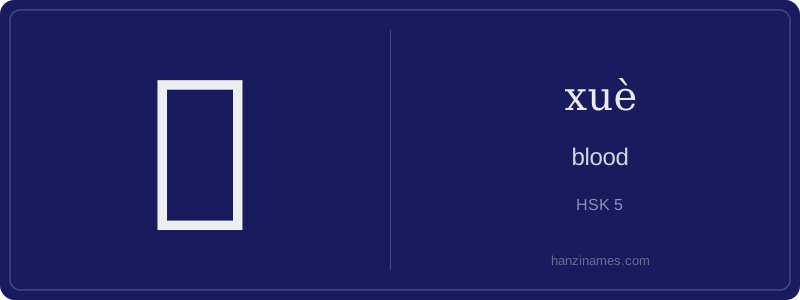
血 is indispensable in modern Chinese: it appears in medical terminology (e.g., 血压 xuèyā 'blood pressure'), legal documents defining biological parentage (血亲 xuèqīn 'consanguineous relative'), and idioms like 血浓于水 (xuè nóng yú shuǐ, 'blood is thicker than water')—a phrase cited in official PRC policy documents on cross-strait relations since the 1980s. It’s also central to public health campaigns, such as无偿献血 (wúcháng xiànxiě, 'voluntary blood donation'), promoted nationwide since the 1998 Blood Donation Law.
The earliest verified form of 血 appears in late Shang oracle bones (c. 1200 BCE) as a pictograph of blood dripping from a sacrificial vessel—confirmed by paleographers like Qiu Xigui. The three dots represent droplets; the lower component mimics a ritual basin. No scholarly debate disputes this origin—it’s one of the clearest surviving pictographs in the script.
As a detective tracing 血 (xuè), I begin at the oracle bone and bronze inscriptions—where early forms depict a vessel containing drops, unmistakably representing blood as a life-substance offered in ritual sacrifice. Its standalone radical status confirms its primacy: few characters serve both as meaning-carrier and structural foundation. The six-stroke modern form preserves this essence—three horizontal dots (blood droplets) above a container-like base—though stylized over millennia.
The character’s phonetic evolution is telling: while pronounced xuè today, older reconstructions (e.g., Middle Chinese *huet*) reflect its ancient link to ritual utterance and vitality. Unlike borrowed or compound characters, 血 resisted simplification—it appears identically in traditional and mainland simplified scripts—underscoring its cultural non-negotiability. Its HSK 5 placement reflects not rarity, but semantic weight: it anchors medical, familial, and moral discourse.
Crucially, 血 never became abstracted into metaphor alone—it retains visceral force. In classical texts like the *Zuo Zhuan*, ‘shedding blood’ (流血) denotes irreversible consequence; in modern Mandarin, ‘blood relationship’ (血缘) legally defines kinship for inheritance law. Even its tone—fourth tone xuè, sharp and falling—mirrors the abruptness of hemorrhage. This isn’t just a word for red liquid; it’s a grammatical pulse point where biology, law, and loyalty converge.
Example Sentences
Common Compounds
Similar Characters — Don't Mix These Up
Your First Step into Chinese Culture: Get a Chinese Name
Every journey into Chinese begins with a name. Use our free Chinese name generator to create a meaningful, personalized Chinese name that fits you perfectly.
Get My Chinese Name →