裔
Character Story & Explanation
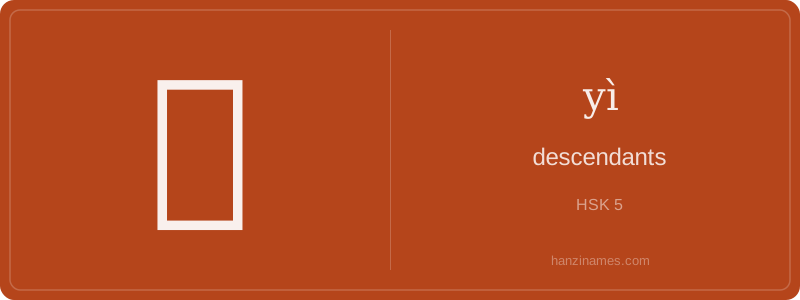
裔 appears frequently in formal and literary contexts—not daily conversation—but is essential in official documents, academic writing, and media discussing diaspora communities. It forms core terms like 华裔 (huáyì, 'ethnic Chinese abroad') and 美裔 (měiyì, 'American descendants'), widely used by Chinese state media and census reports. The term 华裔 is documented in Qing-era records referring to overseas Chinese merchants and appears in 20th-century Republican legal texts defining citizenship by descent.
The character’s form dates to the Warring States period (475–221 BCE), evolving from seal script where 衣 (clothing) served as semantic indicator and 弋 (yì, originally a spear-like tool) provided phonetic guidance. No pictographic origin survives; instead, its composition reflects early phonosemantic principles—common in later bronze and bamboo-slip inscriptions.
The character 裔 (yì) embodies the Confucian reverence for lineage and continuity—where identity is rooted not in the individual alone, but in an unbroken thread stretching backward through generations. Its radical 衣 (clothing) subtly evokes ancestral garments, symbolizing inherited tradition as something worn, carried, and passed down like heirloom robes. In classical thought, being a descendant isn’t passive inheritance but active stewardship: one bears the moral weight and cultural responsibility of forebears.
Unlike Western notions of ‘heritage’ as static legacy, 裔 implies dynamic transmission—language, rites, ethics, even geographical origin—all folded into kinship. Ancient texts use it to denote people from specific regions who migrated and settled elsewhere, retaining their ancestral identity (e.g., 'Yan and Zhao descendants'). This reflects China’s historical consciousness: geography, bloodline, and culture are interwoven in defining belonging.
In modern usage, 裔 anchors diasporic identity—overseas Chinese often identify as 华裔 (huáyì), meaning ‘Chinese descendants’, affirming roots while acknowledging new national contexts. This dual awareness mirrors the character’s structure: 衣 (clothing/identity) + 弋 (a phonetic component historically linked to ‘hunting’ or ‘reaching’) — suggesting both rootedness and extension across borders. Thus, 裔 is not just ‘descendants’ but ‘those who carry forward’.
Example Sentences
Common Compounds
Similar Characters — Don't Mix These Up
Your First Step into Chinese Culture: Get a Chinese Name
Every journey into Chinese begins with a name. Use our free Chinese name generator to create a meaningful, personalized Chinese name that fits you perfectly.
Get My Chinese Name →