览
Character Story & Explanation
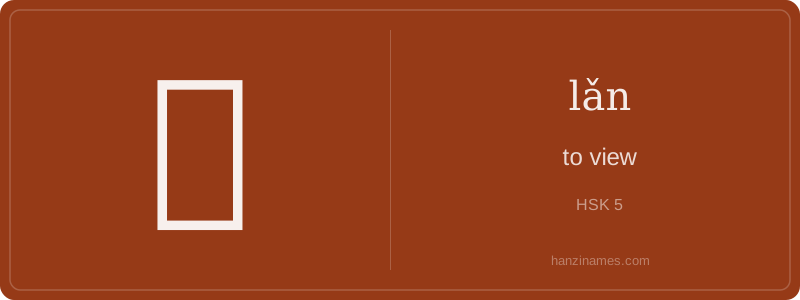
览 is widely used in modern formal and administrative Chinese: in government documents (e.g., 审览 shěnlǎn — 'review for approval'), publishing (审稿前请先览全文, 'Please read the full manuscript before editing'), and digital interfaces (如需预览,请点击, 'Click to preview'). It appears in the idiom 鸟瞰 (niǎokàn, 'bird’s-eye view'), though that uses 瞰; more authentically, it anchors 一览无余 (yī lǎn wú yú) — 'at one glance, nothing remains hidden' — a phrase dating to Song dynasty literary criticism and still used today to describe comprehensive visibility.
The character evolved from seal script, where the left side 覧 was a variant of 监 (jiān, 'to supervise'), and the right side 见 ('to see') was added later for semantic clarity. By the Han dynasty, 览 had standardized as a distinct character meaning 'to inspect thoroughly'. No oracle bone form exists—it first appears reliably in bronze inscriptions and early bamboo slips as a bureaucratic term for official review.
The Chinese character 览 (lǎn) conveys the formal, intentional act of 'viewing' or 'surveying'—not casual glancing, but deliberate, often respectful observation. It appears in contexts like reading documents, touring exhibitions, or reviewing proposals, carrying a tone of authority and attentiveness. Unlike English verbs like 'look' or 'see', 览 implies cognitive engagement: it’s about comprehending through visual inspection, much like a curator examining an artifact or a scholar reviewing ancient texts.
In Western culture, equivalents include 'peruse' (suggesting careful reading), 'survey' (implying broad, systematic observation), or 'behold' (archaic, with reverence). Yet none fully capture 览’s blend of formality, scope, and bureaucratic or scholarly weight. For instance, while 'scan' is quick and superficial, 览 is inherently thorough—even its nine-stroke structure feels methodical, anchored by the 'seeing' radical 见, which grounds all visual cognition in Chinese script.
This character reflects Confucian-influenced values where observation is linked to judgment and responsibility: to 览 a report is to accept accountability for its contents. In contrast, Western viewing metaphors often emphasize individual perception ('I see') or passive reception ('I watch'). 览 instead evokes institutional gaze—the state ‘reviewing’ policies, editors ‘examining’ manuscripts, or emperors ‘inspecting’ tribute. Its usage signals hierarchy, duty, and epistemic seriousness—not just eyes, but mind and office in alignment.
Example Sentences
Common Compounds
Similar Characters — Don't Mix These Up
Your First Step into Chinese Culture: Get a Chinese Name
Every journey into Chinese begins with a name. Use our free Chinese name generator to create a meaningful, personalized Chinese name that fits you perfectly.
Get My Chinese Name →