诊
Character Story & Explanation
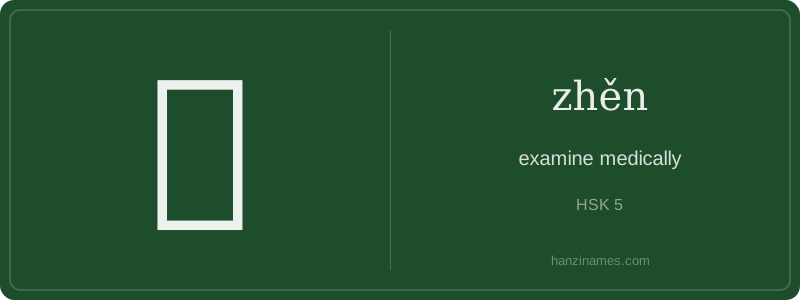
In modern Chinese life, 诊 is ubiquitous in healthcare contexts: people book 门诊 (ménzhěn, outpatient visits), receive 诊疗建议 (zhěnliáo jiànyì, treatment recommendations), and see signs reading 请到诊室等候 (Qǐng dào zhěnshì hòu dài, 'Please wait in the examination room'). Historically, it appears in Song-dynasty medical texts like Taiping Shenghui Fang (10th c.), where 诊脉 (zhěnmài, 'pulse diagnosis') is systematically codified. It’s also central to the phrase 望闻问切 (wàng wén wèn qiè), the Four Diagnostic Methods of Traditional Chinese Medicine—where 诊 implicitly underlies all four.
The character’s form is not pictographic but phono-semantic: 讠 (speech radical) signals the communicative nature of diagnosis, while 寸 (cùn) serves as the phonetic component (though its sound has shifted from ancient *tsʰun to modern zhěn). No oracle-bone or bronze inscriptions contain 诊—it emerged later, during the Warring States period, as medical writing formalized.
Our detective begins at the crime scene: the character 诊, written with just seven strokes and bearing the ‘speech’ radical 讠. At first glance, it seems odd—why use a speech-related component for a medical act? But in ancient China, diagnosis was fundamentally verbal: physicians listened carefully to patients’ descriptions of symptoms, asked probing questions, and discussed findings aloud. The right side, 寸 (cùn), originally depicted a hand’s pulse point on the wrist—a vital site for traditional diagnosis. This wasn’t abstract symbolism; it reflected real clinical practice documented in texts like the Huangdi Neijing (c. 3rd century BCE).
Zooming in further, we find that 诊 evolved from the older character 真 (zhēn, 'true'), which shared the same phonetic component. Over time, the semantic field narrowed: while 真 meant 'authentic', 诊 specialized to mean 'to ascertain truth through examination'—especially of the body. By the Han dynasty, 诊 appears consistently in medical manuscripts as a verb meaning 'to diagnose'. Its compact form—just two components—made it ideal for clinical notes, prescriptions, and imperial medical records where brevity and precision were essential.
The radical 讠 tells us this isn’t passive observation—it’s an interactive, communicative process. A physician doesn’t just *see*; they *listen*, *question*, *interpret*, and *declare*. Even today, when a doctor says 诊断 (zhěnduàn, 'diagnosis'), the 讠 reminds us that diagnosis emerges from dialogue—not just instruments. That’s why 诊 never merged with characters like 检 (jiǎn, 'inspect') or 查 (chá, 'investigate'): its core is human-centered clinical reasoning rooted in language and relational trust. It’s medicine as conversation made visible in ink.
Example Sentences
Common Compounds
Similar Characters — Don't Mix These Up
Your First Step into Chinese Culture: Get a Chinese Name
Every journey into Chinese begins with a name. Use our free Chinese name generator to create a meaningful, personalized Chinese name that fits you perfectly.
Get My Chinese Name →