谦
Character Story & Explanation
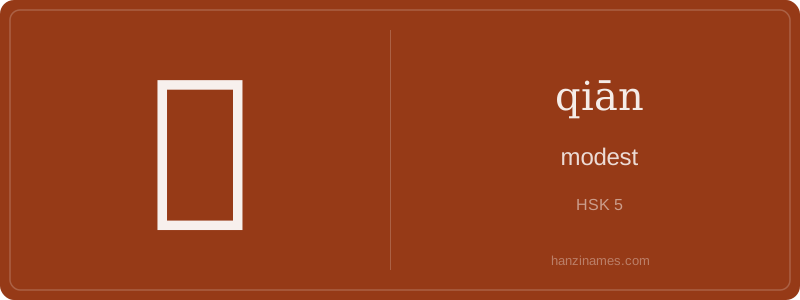
谦 is deeply embedded in modern Chinese communication: it appears in common phrases like '请多指教' (qǐng duō zhǐjiào, 'Please give me guidance') — a standard modest closing in emails or speeches. It’s central to the idiom 谦受益,满招损 (qiān shòuyì, mǎn zhāosǔn): 'Modesty brings benefit; arrogance invites loss' — quoted in official media and textbooks since the Han dynasty and confirmed in the classic *Book of Documents* (Shàngshū). This phrase remains widely taught in schools today.
The character evolved from seal script, where the right side 兼 clearly depicted two hands holding grain stalks — symbolizing 'holding multiple things' (i.e., capacity without excess). By the Han dynasty, it was standardized with the speech radical to emphasize humble expression. No oracle-bone form survives, but its structure has remained stable for over 2,000 years.
Hello students! The character 谦 (qiān) means 'modest' or 'humble' — a core virtue in Chinese culture. It’s written with the speech radical 讠 on the left, showing it relates to how we speak and express ourselves. On the right is 兼 (jiān), which originally meant 'to hold two things at once' and here conveys balance and restraint. Together, they suggest speaking carefully, without boasting — a thoughtful, self-aware way of communicating.
This character appears in formal and everyday contexts: from school essays praising humility to business meetings where leaders say 'I’m still learning' (我还需要学习 — wǒ hái xūyào xuéxí). Unlike English words like 'shy' or 'timid', 谦 carries positive moral weight — it’s admired, not pitied. In Confucian thought, modesty is essential for growth and harmony, making 谦 more than politeness — it’s ethical practice.
At HSK Level 5, 谦 signals your growing grasp of nuanced values. You’ll see it paired with words like 虚 (xū, 'hollow') in 谦虚 (qiānxū, 'modest and humble'), or with 恭 (gōng, 'respectful') in 谦恭 (qiāngōng). Remember: it’s never used alone in speech — always in compounds. Practice writing it slowly: 12 strokes, starting with the 讠 radical. Each stroke reminds us that modesty takes conscious effort — and respect begins with how we choose our words.
Example Sentences
Common Compounds
Similar Characters — Don't Mix These Up
Your First Step into Chinese Culture: Get a Chinese Name
Every journey into Chinese begins with a name. Use our free Chinese name generator to create a meaningful, personalized Chinese name that fits you perfectly.
Get My Chinese Name →