艳
Character Story & Explanation
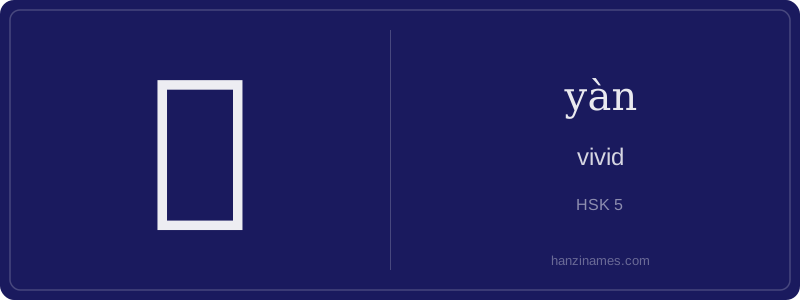
In daily life, 艳 most commonly appears in weather reports (艳阳天 yàn yáng tiān, 'bright sunny day'), fashion journalism ('艳色口红' yàn sè kǒuhóng, 'vivid lipstick'), and classical allusions in literature and film subtitles. Historically, it appears in the 11th-century anthology Yuefu Shiji describing ‘艳妆’ (yàn zhuāng, 'glamorous makeup') of Tang courtesans—documented in Dunhuang manuscripts. The idiom 艳压群芳 (yàn yā qún fāng, 'outshines all other blossoms') remains widely used in media to praise performers’ stage presence.
The character has no verified pictographic origin—it emerged as a phono-semantic compound during the Qin-Han transition. Its left side 色 is a standard radical for appearance-related concepts; the right 丰 originally meant 'bountiful harvest' but served here primarily as a phonetic hint. Today, Chinese speakers instantly recognize 色+丰 as signaling 'intense, eye-catching color or charm'—like spotting a crimson peony in a muted garden.
As a linguistic detective, I begin at the scene: the character 艳 first appears in standardized form during the Han dynasty’s clerical script (lìshū), not earlier oracle bone or bronze inscriptions—meaning its origin is functional, not pictographic. It combines the radical 色 (sè, 'color/appearance') with the phonetic component 丰 (fēng, 'abundant'), signaling both visual richness and aesthetic fullness. This structure reflects early Chinese semantic-phonetic compound logic: meaning anchored in 色, sound borrowed from 丰 (though modern pronunciation diverged to yàn).
The character’s evolution reveals cultural priorities: by the Tang dynasty, 艳 was already entrenched in poetry to describe dazzling beauty—Li Bai used it for radiant flowers and captivating courtesans. Its ten-stroke composition stabilized under the Kangxi Dictionary (1716), where it was classified under 色, confirming its core association with vivid, surface-level allure rather than moral virtue. No ancient variant shows a sun or flame; instead, it’s a deliberate fusion of perceptual impact and phonetic utility.
Modern usage confirms this legacy: 艳 consistently conveys *immediate sensory appeal*—not just brightness, but the kind that arrests attention. Unlike 漂亮 (piàoliang, 'pretty') or 美 (měi, 'beauty'), 艳 carries connotations of boldness, even slight artifice or theatricality. Its HSK 5 placement reflects nuanced literary competence: learners must grasp its emotive weight in idioms like 艳阳高照 (yàn yáng gāo zhào, 'brilliant sunshine') or its subtle irony in phrases like 艳俗 (yàn sú, 'garishly vulgar').
Example Sentences
Common Compounds
Similar Characters — Don't Mix These Up
Your First Step into Chinese Culture: Get a Chinese Name
Every journey into Chinese begins with a name. Use our free Chinese name generator to create a meaningful, personalized Chinese name that fits you perfectly.
Get My Chinese Name →