贝
Character Story & Explanation
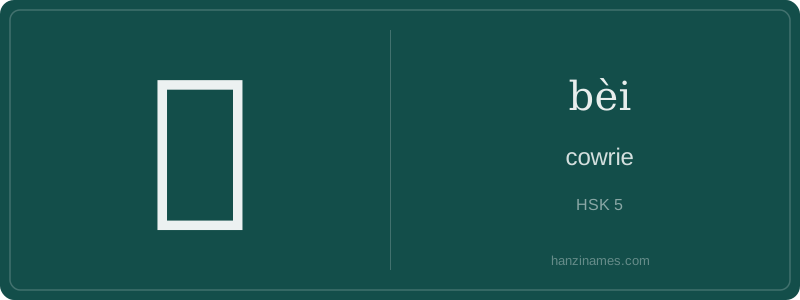
Historically, cowrie shells (贝) served as currency in Shang and Zhou dynasty China (c. 1600–256 BCE), confirmed by archaeological finds—including over 12,000 cowries in Fu Hao’s tomb (c. 1200 BCE). The character appears in oracle bone inscriptions as a clear pictograph of a dorsal shell with groove markings. Later, it became the semantic component in financial terms: 财 (wealth), 账 (account), and 购 (to buy). Today, 贝 survives in formal or literary contexts (e.g., 宝贝, bǎobèi, 'treasure' or 'darling') and compound words like 贝币 (bèibì, 'cowrie money'), taught in history textbooks and museum exhibits.
The earliest form of 贝 in oracle bone script (甲骨文) is a highly recognizable pictograph: a simplified outline of a cowrie shell viewed from above, with a central slit and two lateral grooves—mirroring actual shells used in ancient trade. This visual fidelity confirms its origin as a direct representation of a real, culturally vital object—not an abstract glyph.
The character 贝 (bèi) opens a window into ancient China’s material worldview—where value was not abstract, but tactile and natural. Before metal coins, cowrie shells were currency across Bronze Age China, prized for their luster, durability, and rarity. Their use in trade, burial goods, and ritual offerings reveals how early Chinese society embedded economic, spiritual, and aesthetic meaning into a single organic object—transforming nature into symbol, shell into standard.
As writing evolved, 贝 became a semantic radical—not just for shells, but for anything associated with wealth, exchange, or preciousness. Over 100 characters retain 贝 as their radical: 财 (wealth), 贵 (precious), 购 (to purchase), 贷 (loan). This linguistic fossilization shows how deeply commerce shaped Chinese thought: value wasn’t merely counted—it was *carried*, *worn*, and *honored* like a sacred object.
This worldview endures subtly today. When Chinese speakers say ‘money’ (钱, qián), the right-hand component is 钅 (metal radical), reflecting later coinage—but the left side, 戔, historically derives from a variant of 贝. Even modern finance vocabulary echoes the cowrie’s legacy: ‘investment’ (投资, tóuzī) contains 资, which shares the 贝 radical. Thus, 贝 is more than a character—it’s a cultural palimpsest, layering millennia of economic imagination onto four simple strokes.
Example Sentences
Common Compounds
Similar Characters — Don't Mix These Up
Your First Step into Chinese Culture: Get a Chinese Name
Every journey into Chinese begins with a name. Use our free Chinese name generator to create a meaningful, personalized Chinese name that fits you perfectly.
Get My Chinese Name →