贸
Character Story & Explanation
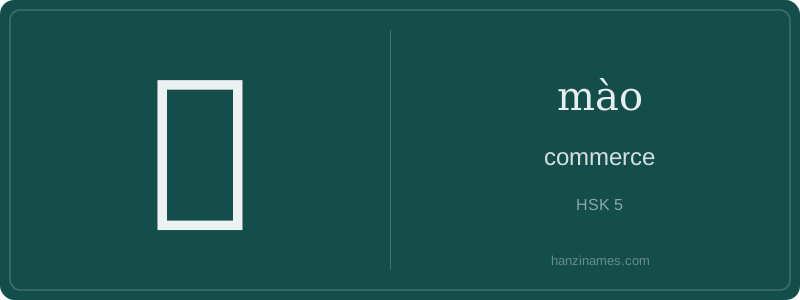
贸 is central to China’s economic vocabulary: it appears in official terms like 对外贸易 (duìwài màoyì, 'foreign trade'), the name of China’s Ministry of Commerce (商务部, Shāngwù Bù), and headlines about Belt and Road Initiative trade deals. The idiom ‘互通有无’ (hùtōng yǒuwú, 'exchange what one has for what one lacks') reflects the classical ideal behind 贸 — mutual benefit through commerce. It’s also in common phrases like ‘外贸公司’ (wàimào gōngsī, 'foreign trade company'), a standard business registration category.
The character’s form evolved from seal script; its left side 贝 is a clear pictograph of a shell — historically verified as early Chinese currency. The right side simplified over time from a complex glyph representing ‘movement across boundaries’, aligning with trade’s cross-regional nature. No oracle-bone form survives for 贸 itself, but 贝 appears in thousands of bronze inscriptions as a monetary radical.
Hi students! Let’s look at the character 贸 (mào), which means 'commerce' or 'trade'. It’s a Level 5 HSK character — so it appears in intermediate-to-advanced vocabulary. Notice its radical 贝 (bèi), meaning 'shell' — an ancient symbol for money in China, since cowrie shells were used as currency over 3,000 years ago. That tells us right away this character is tied to value, exchange, and economic activity.
The right side, 乛 + 冂 + 丶 + 一, isn’t a standalone phonetic but evolved from older forms related to movement and exchange. Together with 贝, it signals dynamic commercial activity — not just static wealth, but buying, selling, importing, exporting. This makes 贸 more specific than general terms like 经济 (economics) — it emphasizes transactional interaction across borders or sectors.
When learning 贸, remember it rarely stands alone in modern Mandarin. You’ll almost always see it in compound words like 贸易 (màoyì, 'trade') or 外贸 (wàimào, 'foreign trade'). Its 9-stroke structure is tidy and balanced: start with the 贝 radical on the left, then write the right component top-to-bottom, left-to-right. Practice writing it slowly while saying 'mào' aloud — that reinforces sound, shape, and meaning together.
Example Sentences
Common Compounds
Similar Characters — Don't Mix These Up
Your First Step into Chinese Culture: Get a Chinese Name
Every journey into Chinese begins with a name. Use our free Chinese name generator to create a meaningful, personalized Chinese name that fits you perfectly.
Get My Chinese Name →