赔
Character Story & Explanation
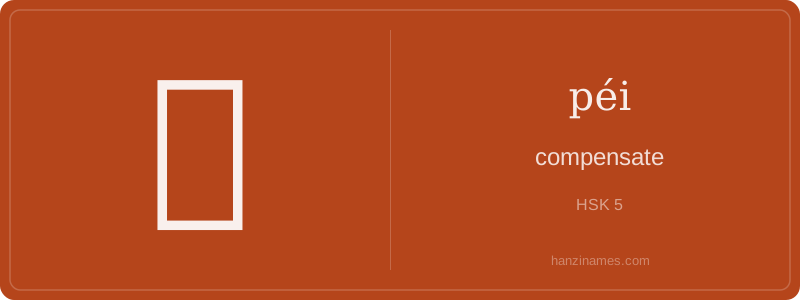
赔 is widely used in modern Chinese legal, commercial, and social contexts. It appears in official documents like the PRC Civil Code (Article 1184), mandating compensation for property damage or personal injury. Common phrases include 赔偿损失 (péicháng sǔnshī, 'compensate for losses') and 赔礼道歉 (péilǐ dàoqiàn, 'apologize and make amends'). It’s also embedded in idioms like 有错就改,错了就赔 (yǒu cuò jiù gǎi, cuò le jiù péi)—a pragmatic civic slogan emphasizing accountability.
Historically, 赔 derives from the ‘shell’ radical 贝 (bèi), reflecting ancient use of cowrie shells as currency. The right side, 倍 (bèi), originally meant ‘double’ or ‘multiple’—suggesting ‘paying back more than the original value’ to restore balance. While oracle-bone forms of 赔 don’t exist (it emerged later, in seal script), its structure consistently links material value (贝) with proportional restitution (倍).
The Chinese character 赔 (péi) conveys the core idea of 'making up for loss'—not merely financial restitution, but moral, relational, or reputational reparation. Unlike Western legal concepts that often emphasize fault and punitive damages, 赔 reflects a Confucian-influenced social ethic where restoring harmony and balance matters more than assigning blame. It implies active responsibility: one doesn’t just pay money; one ‘covers the shortfall’ to realign relationships.
In practice, 赔 appears in contexts ranging from insurance claims to public apologies. For example, when a company issues a formal statement saying ‘我们诚恳赔礼道歉’ (we sincerely apologize and compensate), the word 赔 isn’t about money alone—it signals humility, acknowledgment of harm, and commitment to repair. This holistic sense of redress contrasts with Anglo-American ‘compensation’, which is often narrowly monetary and legally bounded.
Western equivalents like ‘reimburse’, ‘indemnify’, or ‘atone’ each capture fragments of 赔—but none fully encompass its cultural weight. ‘Indemnify’ is too contractual; ‘atone’ too religious; ‘reimburse’ too transactional. 赔 sits at the intersection of ethics, economics, and face-saving—a linguistic artifact of China’s relational worldview, where loss disrupts harmony, and compensation is the first step toward reconciliation.
Example Sentences
Common Compounds
Similar Characters — Don't Mix These Up
Your First Step into Chinese Culture: Get a Chinese Name
Every journey into Chinese begins with a name. Use our free Chinese name generator to create a meaningful, personalized Chinese name that fits you perfectly.
Get My Chinese Name →