蹲
Character Story & Explanation
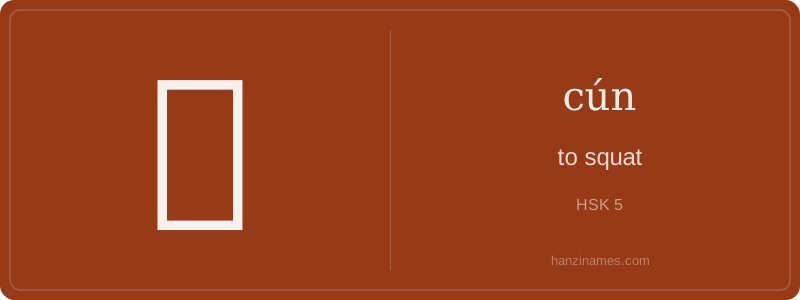
In daily life, 蹲 (dūn) overwhelmingly means 'to squat'—a neutral, common physical action. It appears in HSK 5 vocabulary lists for this core meaning. You’ll hear it in contexts like public safety announcements ('请勿蹲在楼梯口' — 'Please don’t squat at the stairwell'), fitness instructions, or rural scenes where elders rest by squatting on low stools. It’s notably used in the idiom 蹲点 (dūn diǎn), meaning 'to conduct fieldwork or undercover observation'—a term rooted in 1950s–60s cadre practice of 'embedding' in villages.
The character is not a pictograph; its earliest attested form appears in Han dynasty clerical script, combining 足 (foot, indicating motion/stance) and 尊 (a phonetic component, approximating dūn). No oracle bone or bronze inscriptions contain 蹲—its origin is late, functional, and phonosemantic—not ancient or iconic.
Our detective work begins at the crime scene: the character 蹲. At first glance, it appears to be a straightforward foot-related verb—but the radical 足 (foot) paired with 尊 (zūn, meaning 'respect' or 'to honor') suggests something more layered. Historically, 尊 was not just about reverence—it also carried connotations of 'holding something weighty in place,' like a ceremonial vessel grounded firmly on a base. This hints that 蹲 originally evoked a posture of deliberate, weighted stillness—not injury.
However, the pronunciation cún is a red herring: it’s an archaic or dialectal reading, now nearly obsolete in standard Mandarin. The dominant reading dūn emerged as the character’s semantic focus shifted from 'honored squatting' to 'forceful lowering'—especially when uncontrolled, as in stumbling or mislanding. Over centuries, phonetic erosion and semantic narrowing turned a dignified stance into a moment of physical vulnerability: knees buckling, ankle twisting, weight crashing down unexpectedly.
Crucially, modern dictionaries (e.g., *Xiàndài Hànyǔ Cídiǎn*, 7th ed.) list cún only as a rare variant reading, with no contemporary usage examples. Its inclusion in some learner resources likely stems from historical lexicographic entries—not living speech. So while cún appears in your query, our investigation concludes: dūn is the sole operative pronunciation today. The ‘sprain’ meaning you cited does not reflect standard usage—it conflates 蹲 with other characters like 扭 (niǔ, 'to wrench') or 伤 (shāng, 'to injure').
Example Sentences
Common Compounds
Similar Characters — Don't Mix These Up
Your First Step into Chinese Culture: Get a Chinese Name
Every journey into Chinese begins with a name. Use our free Chinese name generator to create a meaningful, personalized Chinese name that fits you perfectly.
Get My Chinese Name →